

Why Table Width Matters More Than Table Length
Length decides how many people can sit down. Width decides whether any of them are actually comfortable once they do.
Table length gets nearly all the attention during specification, because it maps directly to seating count — a number everyone can picture and plan around. Width gets treated as an afterthought, usually settled on whatever the standard proportion happens to be. That's backwards. Width is the dimension that determines whether a table actually feels comfortable to sit at, serve from, and hold a conversation across — and it deserves the same deliberate attention length gets.
What Width Actually Controls
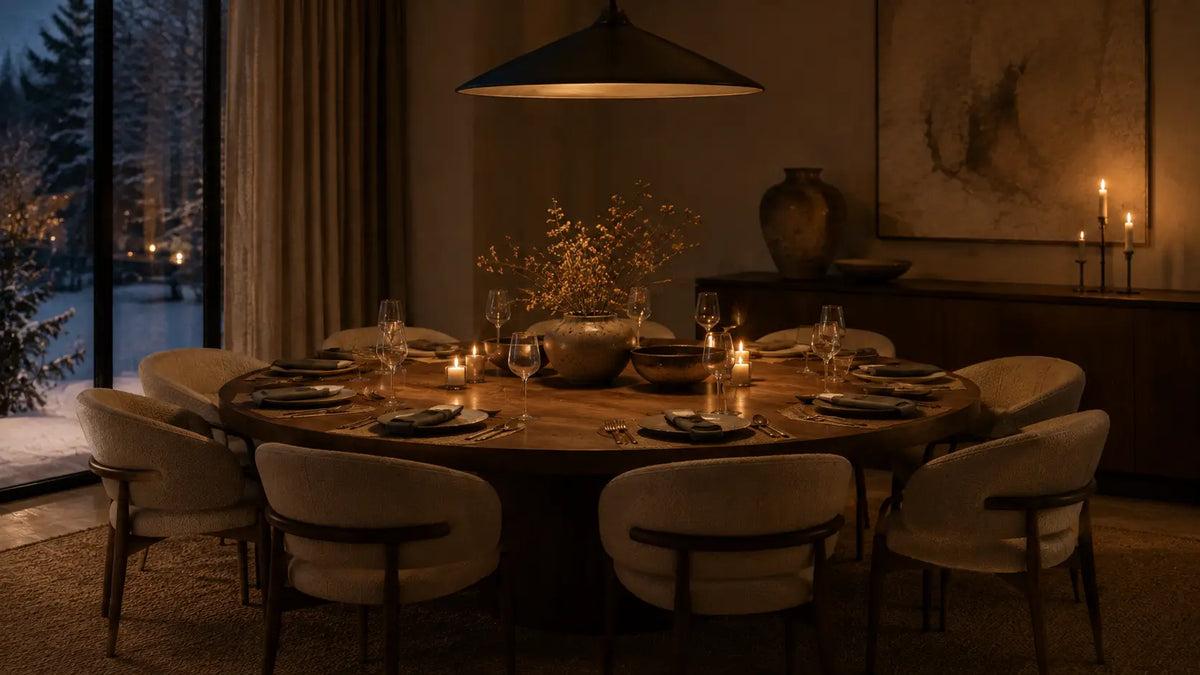
Three things depend on width, and none of them depend on length. Elbow room: a narrow table puts seated guests closer to the table's centerline on both sides, which can feel cramped regardless of how much space exists lengthwise. Reach across the table: shared dishes, a bread basket, a bottle of wine — all become an genuine stretch on a table that's too wide relative to its use, or feel crowded on a table too narrow to hold both place settings and serveware. And room for a centerpiece: a runner, a vase, a bowl — anything placed down the table's center needs width to exist without encroaching on either side's place setting.
The Minimum That's Too Often Ignored
A width below roughly 36 in / 90 cm feels tight for genuine comfort — place settings crowd the centerline and any centerpiece competes directly with the food. A width of 40–44 in / 100–110 cm is the range that consistently performs well: enough room for full place settings on both sides plus a runner or centerpiece down the middle, without requiring guests to reach uncomfortably far across for shared dishes. Below the minimum, a table can look proportionally correct in a rendering and still feel cramped the first time it's actually set for a full dinner.
Why Narrow Tables Feel Cramped Even When Long
A long, narrow table can seat a large group on paper while feeling tight to every single guest at it — length adds seats, but it does nothing to solve a width problem. Conversation across a too-narrow table also suffers in the opposite way once width increases past a certain point: a table wide enough to feel spacious can become too wide to comfortably talk across without raising your voice. The right width isn't the maximum available — it's the width that keeps every seat comfortable without stretching conversation past a natural distance.
- Treat width with the same deliberate attention as length, not as a default
- Specify at least 36 in / 90 cm width — 40–44 in / 100–110 cm for genuine comfort
- Confirm the table can hold full place settings plus a centerpiece without crowding
- Don't assume a long table automatically feels spacious — width solves comfort, not length
- Balance width against conversational distance — wider isn't always better
A table's length gets planned around how many people you're inviting. Its width should be planned around how comfortable they'll actually be once they sit down.
Our studio specifies width as deliberately as length on every commissioned table, sized to how the piece will actually be used and set. If you're finalizing dimensions for a table, our studio team is available to walk through the proportions directly.

Leave a comment
This site is protected by hCaptcha and the hCaptcha Privacy Policy and Terms of Service apply.