
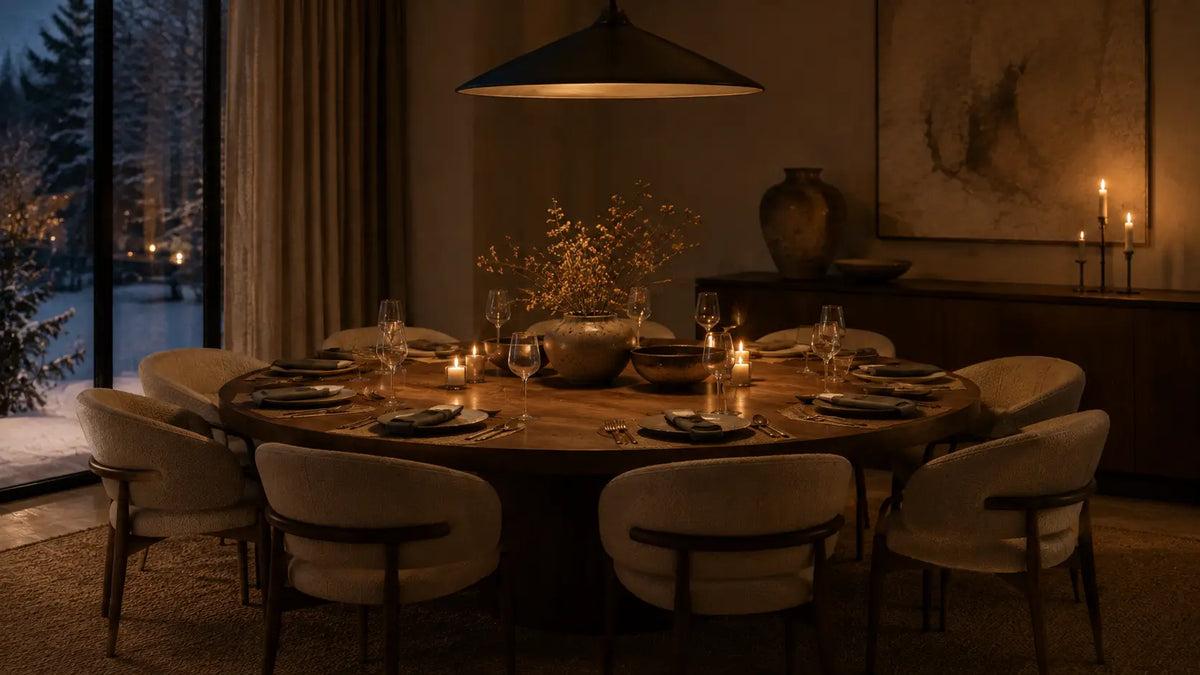
The Winter Dining Room: How the Brief Changes with the Season
A dining room specified only for summer daylight is only half-finished. Winter changes how the room is lit, how it's used, and how its materials actually feel.
Most dining room briefs are developed and approved during a site visit that happens to fall in whatever season the project is running — and the specification rarely gets revisited for how the room will perform in the opposite season. Winter changes more than the light outside the window. It changes usage patterns, material perception, and even the physical behavior of solid wood. A room specified without this in mind is only correct for part of the year.
The Light Changes, and So Should the Plan
Winter's shorter days mean a dining room spends far more of its actual use under artificial or candle light than it does in summer, when long evenings extend usable daylight well into dinner hours. This doesn't mean waiting for winter to specify — it means testing swatches and samples under warm artificial light (roughly 2700–3000K, the range most residential dining fixtures use) rather than relying only on how a material looks under bright daytime light in a showroom. A studio can walk a client through this regardless of when in the year the commission happens — the goal is matching the light the room will actually be used in, not matching the calendar.
 Même plateau en chêne massif sous deux températures de couleur — 5000K (lumière du jour neutre) à gauche, 2700K (lumière artificielle chaude) à droite.
Entertaining Patterns Shift
Winter — particularly the holiday season — is disproportionately when households host their largest and most frequent gatherings, even if the room's daily footprint the rest of the year is much smaller. This argues for genuinely considering an extendable table specification, or at minimum confirming the room can accommodate additional seating during the specific weeks it will actually be needed. A table sized precisely for the household's everyday winter-excluded use can leave the room unable to handle exactly the gatherings it was arguably commissioned for in the first place.
Material Warmth Becomes More Noticeable
The tactile difference between stone and wood, discussed elsewhere in this series as a year-round consideration, becomes considerably more pronounced in winter. A stone tabletop that reads as pleasantly cool in summer can feel genuinely cold to the touch in a winter dining room, particularly near drafty windows or on homes without radiant floor heating beneath the space. This doesn't disqualify stone as a winter specification, but it's worth discussing directly with the household — some owners specifically want a warmer wood surface for the season the dining room gets used most, while others prefer stone regardless and simply adjust with table linens.
Heating Proximity and Wood Movement
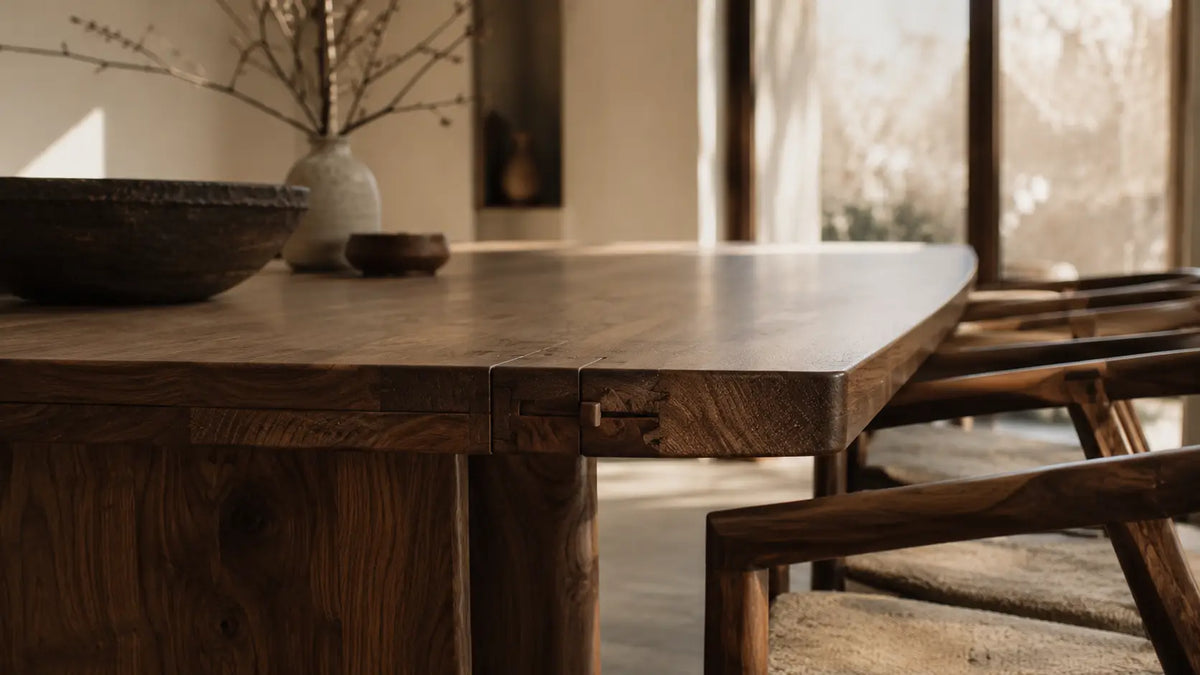
This is a genuine technical consideration too often skipped. Dining rooms near a working fireplace, a radiator, or any zone with significant winter heating see meaningful swings in relative humidity as heated air dries out compared to summer conditions. Solid wood expands and contracts with humidity, and a table placed too close to a consistent heat source without adequate construction allowances for wood movement risks visible cracking or joint stress over repeated winter seasons. Any commissioned wood table for a room with substantial winter heating nearby should be built with this movement explicitly accounted for in its construction — this is a conversation worth having directly during the commissioning process, not an assumption to leave unstated.
Layering for the Season
The rug, textile, and styling choices discussed elsewhere in this series can shift seasonally without requiring a full re-specification of the room. A slightly heavier-feeling textile on chair upholstery, a seasonal rotation of the single centerpiece object toward something that reads warmer for winter months, and candlelight incorporated into the room's evening use all layer onto a well-specified base without requiring structural changes. The base specification — table, chairs, rug, sideboard — should be chosen to perform year-round; the seasonal layer sits on top of that foundation rather than replacing it.
Winter Specification Checklist by Category
| Category | Winter Consideration |
|---|---|
| Material selection | Test under warm artificial light (2700–3000K), any time of year |
| Table sizing | Consider extendable capacity for holiday-season gatherings |
| Tabletop material | Discuss stone's cold touch directly if the room sees heavy winter use |
| Solid wood construction | Confirm wood movement allowances if near a fireplace or radiator |
| Styling and textiles | Layer seasonally on top of a year-round base specification |
- Test materials and finishes under warm artificial light (2700–3000K) — not just daylight — regardless of the season you're ordering in
- Confirm seating capacity works for holiday-season entertaining, not just daily use
- Discuss stone's winter cold-touch directly if the room sees heavy seasonal use
- Specify wood movement allowances for tables near fireplaces or radiators
- Treat seasonal styling as a layer on top of the base specification, not a replacement for it
A dining room built for one season is a dining room half-specified. Winter deserves the same deliberate attention summer gets by default.
Our studio accounts for seasonal use — light, heating proximity, and entertaining patterns — when specifying tables and chairs for year-round rooms. If you're planning a dining room brief and want to make sure it performs through winter, our studio team is available to walk through the specification directly.


Leave a comment
This site is protected by hCaptcha and the hCaptcha Privacy Policy and Terms of Service apply.