
Quartzite vs Marble: The Specification Decision Nobody Explains Clearly
Quartzite and marble get sold as interchangeable luxury stone. Geologically, they are almost nothing alike — and that difference determines how the table will actually perform.
Quartzite and marble are routinely presented as two flavors of the same decision — pick the veining pattern you prefer and move on. That framing skips the fact that these are structurally different materials, formed by different processes, with meaningfully different performance characteristics. The specification decision deserves the same rigor as any other material choice in this series, and it starts with understanding what each stone actually is.
What They Actually Are
Marble forms from metamorphosed limestone, composed primarily of calcite — a soft, chemically reactive mineral. Quartzite forms from metamorphosed sandstone, composed primarily of quartz — one of the hardest, most chemically stable minerals available in natural stone. This single geological fact drives almost every practical difference between the two materials. Marble's softness is what gives it the ability to be carved and polished to a particular luster; quartzite's hardness is what gives it exceptional resistance to scratching, etching, and heat.
Durability and Etching
This is the most consequential practical difference for a dining table. Marble's calcite reacts visibly to acid — wine, citrus juice, vinegar, and many common cleaning products — causing a dull, etched mark on the surface that polishing can minimize but not always fully remove. This is a well-documented characteristic of marble, not a manufacturing defect, and any marble dining table should be specified with the understanding that etching will occur over time with regular use. Quartzite's quartz composition makes it dramatically more resistant to acid etching — a genuine quartzite top can tolerate the kind of daily food and beverage contact a dining table experiences without the same visible reaction.

Veining and Visual Character
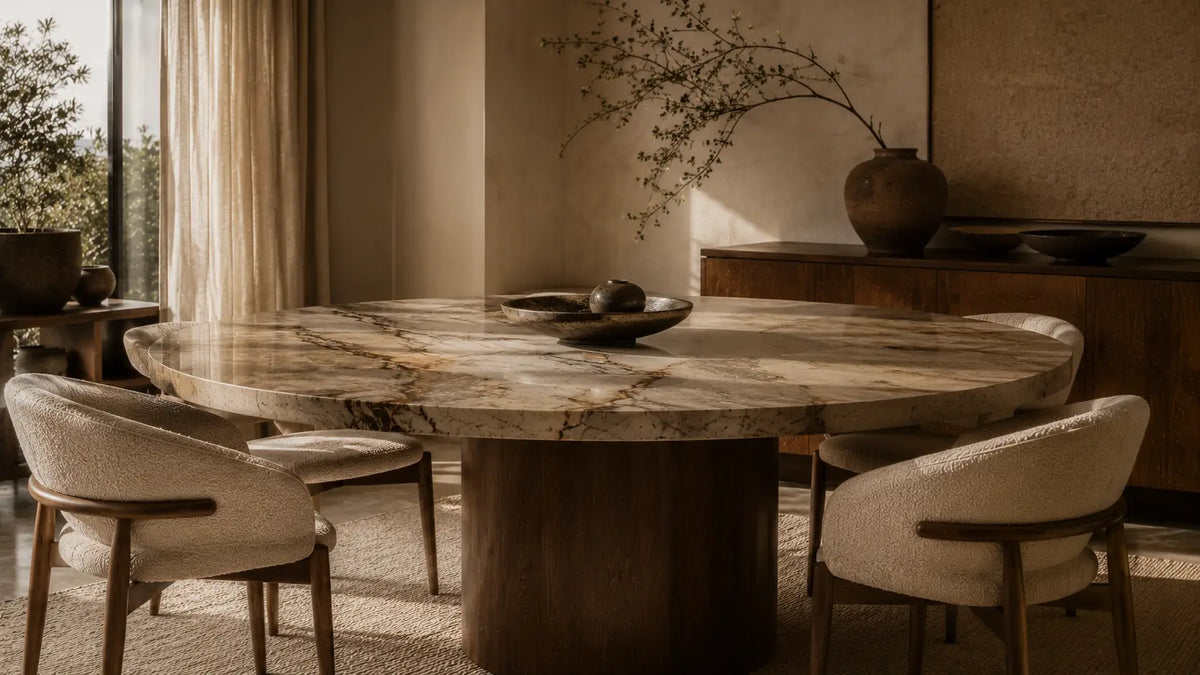
Marble is prized for dramatic, flowing veining — the material most people picture when they imagine luxury stone, with strong contrast and organic movement across the slab. Quartzite's natural veining tends to be more subtle and linear in most varieties, though certain high-end quartzites have become sought after precisely because they mimic marble's dramatic veining while retaining quartzite's durability — these particular slabs command a significant premium specifically because they deliver both qualities at once, and they're relatively rare in the quarrying process.
The Labeling Problem
The stone trade has a well-known labeling issue: some slabs sold commercially as "quartzite" are actually dolomitic marble or other calcite-based stones with a similar appearance but none of quartzite's actual hardness or etch resistance. This isn't always intentional deception — the terminology has been used loosely in the trade for years — but it means a buyer specifically choosing quartzite for its durability characteristics should verify what they're actually getting. A genuine quartzite will scratch a piece of glass and will not visibly etch from a drop of lemon juice left for several minutes; a dolomitic marble mislabeled as quartzite will etch under the same test. Any serious studio or fabricator should be able to confirm material identity with documentation, not just a name on an invoice.
Price and Availability
Genuine high-quality quartzite is often more expensive than comparable marble, largely because its hardness makes it significantly more difficult and slower to quarry, cut, and polish — the same property that gives it durability also gives fabricators a harder material to work with. Marble is more widely available across a broader range of price points, from accessible options to the most rare and expensive slabs in the stone trade. Buyers should expect to pay a premium for genuine, well-documented quartzite, and should treat an unusually low price on a "quartzite" slab as a reason to verify the material rather than a bargain.
Direct Comparison
| Criterion | Marble | Quartzite |
|---|---|---|
| Primary mineral | Calcite (soft) | Quartz (very hard) |
| Acid etching | Visible, expected over time | Highly resistant |
| Scratch resistance | Moderate | Excellent |
| Typical veining | Dramatic, flowing | Subtle to linear, some dramatic exceptions |
| Price range | Broad — accessible to very high-end | Generally higher, premium for genuine material |
| Labeling risk | Low | Higher — verify material identity |
- Understand the mineral difference — calcite (marble) is soft and reactive, quartz (quartzite) is hard and stable
- Expect visible etching on marble over years of daily use — this is normal, not a defect
- Choose quartzite if acid and scratch resistance are priorities for daily use
- Verify quartzite identity with documentation — commercial mislabeling is common
- Budget for a premium on genuine, well-documented quartzite
Marble and quartzite are not two versions of the same choice. They are two different materials, and the right one depends on how much daily wear the table will actually see.
Our studio sources and verifies both marble and genuine quartzite for tabletop fabrication, with documentation available on material identity. If you're deciding between the two for a commissioned table, our studio team is available to walk through the tradeoffs directly.


Leave a comment
This site is protected by hCaptcha and the hCaptcha Privacy Policy and Terms of Service apply.