
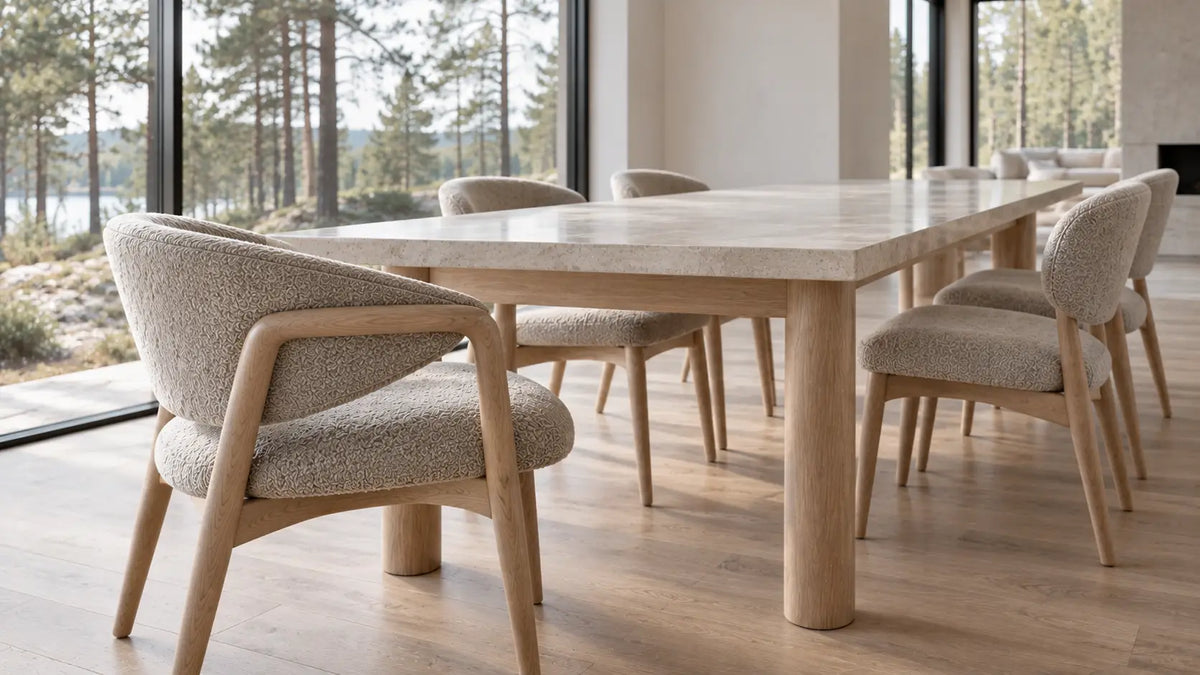
The Armchair at the Head of the Table: When and How
A head chair is not a bigger chair. It is the one seat in the room that has to look intended.
On a long dining table, the two end seats are the first thing the eye reads and the last thing most specifications address. They are often filled with the same chair as the sides, or with an armchair chosen for its look rather than its fit. A head chair does earn its place on the right table. It also asks for more width, more clearance, and a little more discipline than the chairs along the sides.
When a Head Chair Earns Its Place
The head chair belongs to rectangular tables, and in practice to tables long enough to need it: roughly 2.2 m / 87 in and above, where the table seats eight or more and the ends become genuine positions rather than overflow. On a round or oval table there is no head, and an armchair simply becomes one more seat. On a short rectangular table of six or fewer, an end armchair tends to crowd the corners and turns a balanced table into one dominated by its ends.
Wider, Not Taller
The head chair signals hierarchy through width, not height. A side chair typically has a seat 18–20 in / 46–51 cm wide; an armchair for the head runs 22–25 in / 56–64 cm, enough for arms without cramping the sitter. A back one or two inches taller than its neighbors can mark the position, but the seat height should match the side chairs exactly. If the head seat sits higher, the person in it looks down the table, and the whole line of seating breaks. Matching seat height is the one rule worth treating as non-negotiable.
Space Behind the Seat
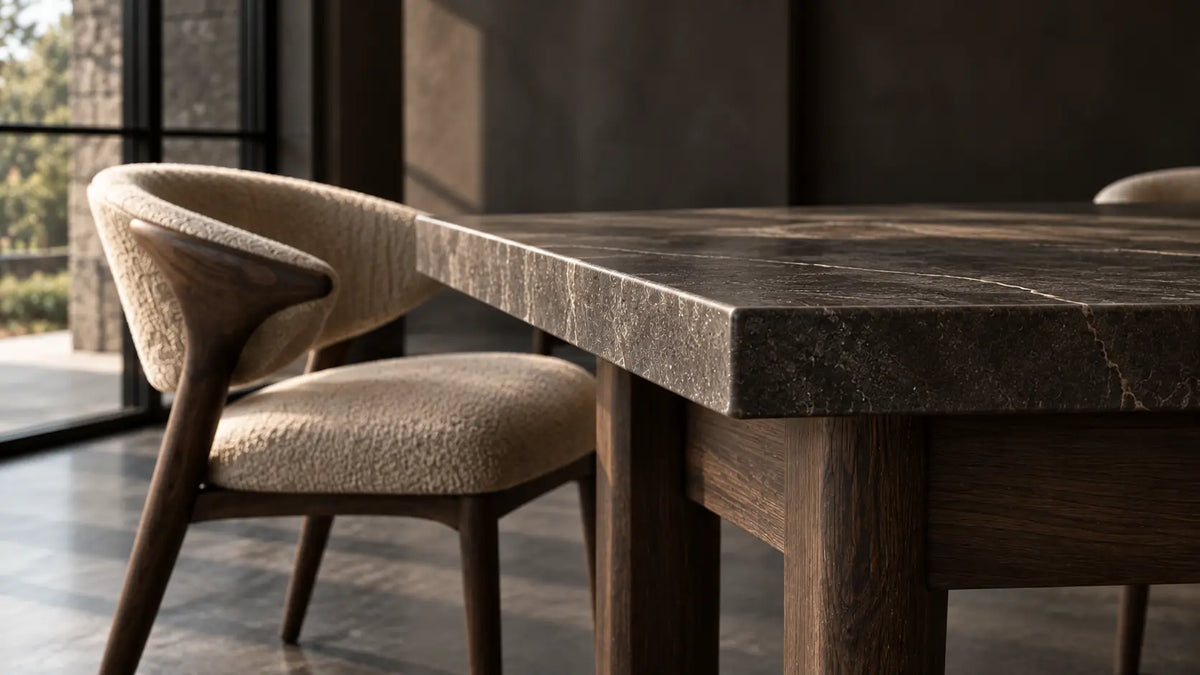
An armchair pulls out further than a side chair and takes more room to do so. Allow at least 36 in / 91 cm between the table's end and the nearest wall or piece of furniture so the chair can be moved comfortably. If people will pass behind it, plan 42–48 in / 107–122 cm instead. Head seats often face a window or sit against a wall, which makes this clearance easy to underestimate: a head chair that cannot be pulled back freely ends up half in, half out, and the end of the table loses its use. The arm height must also clear the underside of the apron, as covered in the piece on seat and table heights, so that the chair slides in cleanly when the table is cleared.
Same Family or Deliberate Contrast
There are two coherent approaches. The first is the same chair family throughout, with the head position given arms and the sides without. The same frame, the same upholstery, and the same seat height read as a single set with a quiet change of rank. The second is a deliberate contrast: a different silhouette or material at the head, as discussed in the piece on mixing chair styles, which works only when the proportions and the seat height still align. What does not work is a head chair that matches neither the sides nor makes a clear point of difference. It reads as an accident.
- Head chairs suit rectangular tables of about 2.2 m / 87 in and longer, not round or oval
- Choose width over height: a 22–25 in / 56–64 cm seat, with seat height identical to the side chairs
- Leave at least 36 in / 91 cm behind the seat, or 42–48 in / 107–122 cm if people pass
- Check that the arm height clears the apron so the chair tucks in
- Pick one approach: the same family with arms added, or a clear and deliberate contrast
The ends of a long table are not leftover seats. They are where the table finishes its sentence.
Our studio builds dining tables and chairs to order, sized to the room and the number of people it will seat. If you're planning a long table with chairs at the ends, our studio team is available to discuss the proportions directly.

Leave a comment
This site is protected by hCaptcha and the hCaptcha Privacy Policy and Terms of Service apply.