
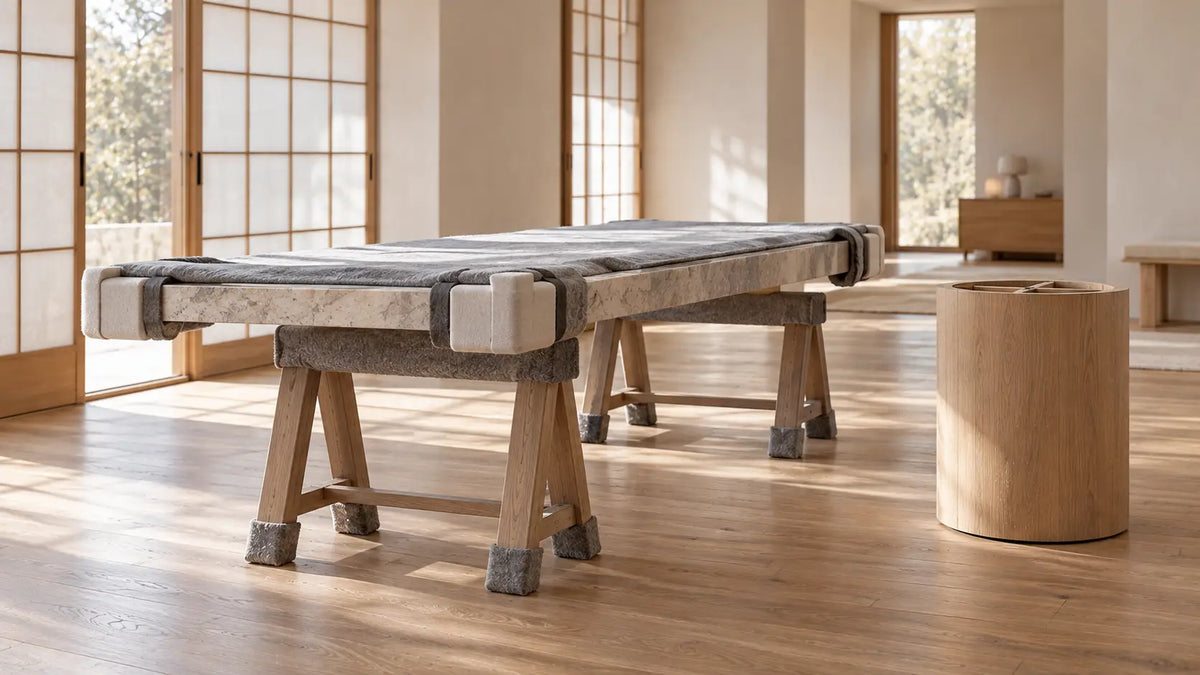
How a Stone Dining Table Arrives: Weight, Access, Installation
A stone table is designed for the room it will stand in. It is delivered through every doorway, stair, and corner that comes before it.
The conversation about a stone dining table usually ends at the order. The part that follows — a slab weighing well over a hundred kilos travelling from a workshop to a dining room, through a building that was never planned around it — is where many projects quietly go wrong. Almost none of it is difficult when planned. Almost all of it is expensive or impossible when discovered on the day. This guide covers what a stone table weighs, how it travels, what the route has to allow, and what to check when it arrives.
The Top Travels Separately From the Base
A stone dining table is not delivered assembled. The top and the base travel as two pieces, and they are packed differently. The top is the vulnerable one: it is carried on its edge, protected by rigid corner and edge guards, and secured in a crate or a padded frame so that it never bears its own weight flat in transit. A slab is far stronger in compression than in bending, and it is most likely to crack when lifted or carried flat without support along its length. The base, whether solid wood or stone, ships separately, wrapped and padded, and is joined to the top on site, in its final position. The table is assembled in the room, not carried in as a finished object.
Weight and What It Means
Natural stone weighs roughly 2.7 tonnes per cubic metre, which at a thickness of 3 cm / 1.2 in comes to about 80 kg per square metre, or 16 lb per square foot. That figure is for the stone alone, before the base.
| Seating | Typical Rectangular Top | Approximate Stone Weight at 3 cm |
|---|---|---|
| 6 seats | 180 x 100 cm / 71 x 39 in | about 145 kg / 320 lb |
| 8 seats | 240 x 105 cm / 94 x 41 in | about 205 kg / 450 lb |
| 10 seats | 280 x 110 cm / 110 x 43 in | about 250 kg / 550 lb |
Oval and round tops of the same seating weigh roughly a fifth less. These are the weights of a single piece that has to be moved by several people with proper equipment, which is why a stone top is lifted with suction handles and a team rather than carried by hand, and why the number of people on the delivery crew matters.
Measure the Route, Not Just the Room
Most dimensional planning stops at the dining room itself. A stone table needs to be planned from the street door to the final position. A slab travels on its edge, so its long dimension has to clear every doorway as a height and every turn as a length. The usual obstacles are tight stair landings, narrow or low door frames, elevators with shallow cars, hallway turns that need the full length of the slab to swing, and thresholds with steps or sills. A table that fits in the room can still be undeliverable if the route cannot take it.
This is best discovered before fabrication, not after. Access constraints can decide whether the top is made as a single piece or in sections, which is a design decision that affects where the joint falls and how the stone's veining is read. It is also far cheaper to adjust at the drawing stage than to hoist a slab through a window or send it back.
What White-Glove Delivery Should Include
A proper delivery to a high-end residence is not a curbside drop. It should include a crew sized to the weight of the top, unloading and carrying to the room, assembly of the base, placement of the top, leveling, removal of all packaging, and a final inspection with the client or the designer present. Floor protection along the route matters as much as the stone itself: a dropped corner on a wood floor is as damaging as a chipped slab. For international deliveries to the United States, the same standard applies at the final mile, with customs clearance and insured freight handled before the truck reaches the door.
Upper Floors and Floor Loading
A stone dining table with its base typically weighs 200–350 kg / 450–770 lb, spread across the base footprint. In most modern buildings this is well within normal residential floor capacity, but upper-floor apartments, older buildings, and rooms with a long-span timber floor deserve a second look. The question is not only the load but the route: a stone table going to an upper floor needs an elevator that can take the slab on its edge, or a stair that can be climbed with a team and a slab of that length. If neither works, the alternative is a window or balcony hoist, which has to be arranged and insured separately.
Order of Works: The Table Arrives Last
A stone table should be the last significant item to enter a room. Painting, floor finishing, and any work involving dust or heavy traffic should be complete first, since the stone is both an obstacle in a working room and a surface that can be marked by it. Build the delivery date into the project calendar after the room is finished, and confirm that the site will be accessible and clear on the day.
Inspecting on Arrival
Inspection happens at the door, with the crew present, before the packaging is discarded and before the delivery receipt is signed. Check the edges and corners for chips, the surface for scratches or marks, and the underside for any hairline cracks. Photograph everything, note any damage on the receipt, and report it immediately: carrier claims have short windows, and damage found a week later is far harder to settle. The table should then be placed, leveled on its base, and checked once more in its final position.
- Expect the top and the base to arrive separately and be assembled in the room
- Know the stone weight for your table size, and confirm the delivery crew is sized for it
- Measure the whole route — street door, stairs, elevator, turns, thresholds — before fabrication
- Decide early whether access requires a top made in sections
- Require white-glove delivery with floor protection, assembly, leveling, and packaging removal
- For upper floors, confirm elevator capacity or arrange a hoist in advance
- Schedule delivery after painting and floor works are finished
- Inspect at the door, photograph everything, and note any damage on the receipt before signing
The last few meters of a stone table's journey decide whether the first year of ownership begins with a dinner or a claim.
Our studio builds dining tables to order. If you're planning a stone table and want to review the route into the room before the design is fixed, our studio team is available to discuss the logistics directly.



Leave a comment
This site is protected by hCaptcha and the hCaptcha Privacy Policy and Terms of Service apply.