
Table Edge Profiles: What the Edge Does That the Top Cannot
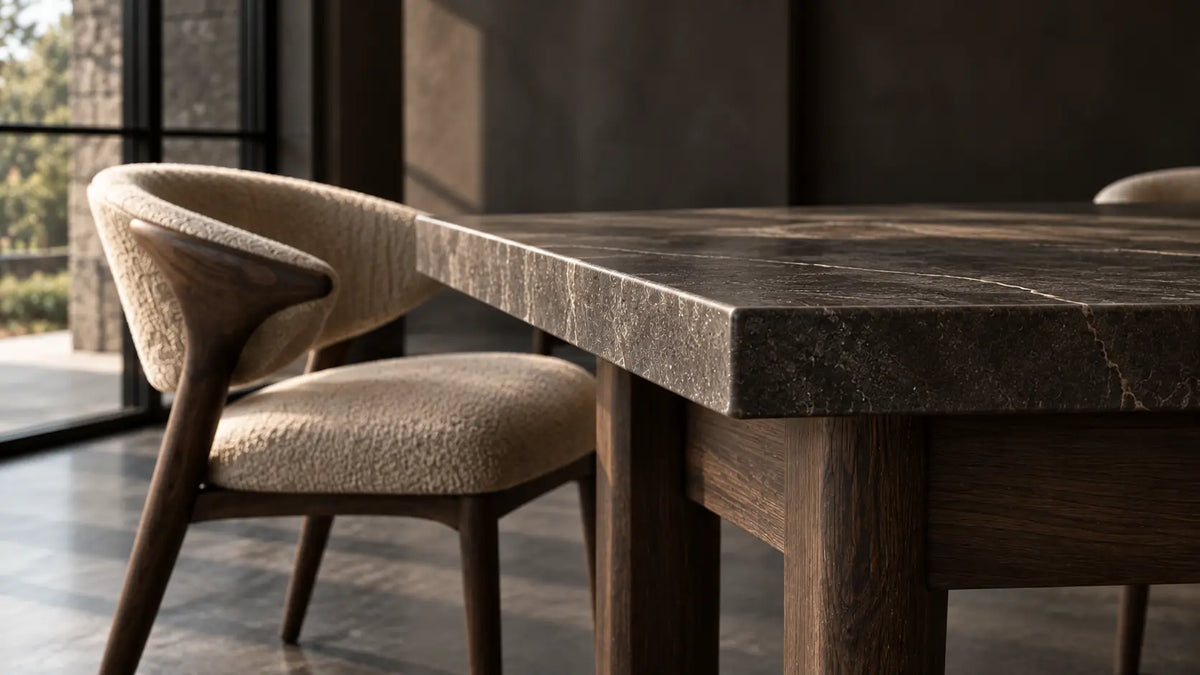
The tabletop is what the eye sees. The edge is what the hand, the forearm, and the first accidental knock actually meet.
Dining table specification spends its time on material, shape, and size, then hands the edge to the fabricator as a detail. That is a mistake. The edge profile decides how thin or heavy the top appears, how it feels under a forearm, how it survives a dropped serving dish, and whether the table still looks sharp after fifteen years of use. It costs nothing in floor space and changes almost everything about daily contact. This guide covers the profiles that matter for stone and solid wood tops, and the trade each one makes.
The Edge Is Where the Table Meets the Body
Every diner touches the edge dozens of times per meal: forearms rest on it, hands slide along it, hips brush it when standing up, and children catch it at head height. It is also the most exposed surface on the table, the one point where a chair back, a tray, or a vacuum cleaner is most likely to land. A tabletop face is a flat surface that rarely takes an impact. An edge is a corner, and corners are where materials fail first. Choosing a profile is therefore a decision about wear as much as appearance.
Square With an Eased Arris
The square edge is the baseline of contemporary design: a flat vertical face meeting the top at a crisp right angle. Its strength is clarity. It makes a top read as a single, intentional slab, and it suits the quiet, architectural character that most stone and wood tables are built to project.
A truly sharp ninety-degree corner is a liability in any material, however. On stone, the arris — the line where two surfaces meet — chips easily under a light knock, and a chip on a stone edge is a repair for a specialist, not something an owner can sand out, as discussed in the stone-versus-wood comparison earlier in this series. On wood, a razor corner dents and wears through its finish first. The standard answer is an eased arris: a radius of roughly 1–2 mm / 1/16 in along the edge, enough to remove the fragility without changing the visual character. Almost every well-made square-edged table has this, and it is almost always worth specifying explicitly rather than assuming.
Chamfer and Underbevel
A chamfer replaces the corner with a flat angled facet. An underbevel is its more refined cousin: the angle is cut on the underside of the top, so the visible edge slopes inward and away, leaving only a thin lip on the upper surface.
The underbevel is the profile of choice when a top needs to look lighter than it is. A stone slab of 3 cm / 1.2 in can read as roughly half that thickness, because the eye sees only the upper lip and the shadow beneath it. This creates a clean shadow line between the top and the base and reduces the perceived mass of a large table significantly. The trade is the lip itself: the thin upper edge is the most vulnerable part of the profile, so it needs enough remaining thickness to resist chipping, and it is worth confirming that figure with the fabricator rather than leaving it to the visual.
Bullnose and Demi-Bullnose
A bullnose rounds the edge into a full semicircle. A demi-bullnose rounds the upper corner only, leaving the lower half square. Both are the soft options, and both are the most forgiving profiles for daily life: there is no corner to chip, no point to catch on clothing, and no hard line against a forearm.
This is why a bullnose suits households with young children and tables that see heavy informal use. It also has a visual character — softer, slightly more traditional — that does not suit every room. In stone, a full bullnose also asks for slab thickness: the radius is half the thickness, so a 3 cm top produces a 1.5 cm radius, and the machining removes material and adds cost. A demi-bullnose is often the better compromise on stone, since it keeps the clean vertical face while protecting the upper corner that contacts the arm.
The Mitered Edge
A mitered edge is built rather than cut: the top and a downturned strip of the same stone are joined at forty-five degrees, so the corner reads as one continuous piece of material with the vein running over the edge. The result is a top that appears 5–6 cm / 2 in or more thick while using a lighter slab underneath.
For a statement stone with dramatic veining, this is the most visually resolved edge available: the pattern wraps around the corner without a break. The trade is fabrication quality and cost. The joint must be tight and the vein must match across it, which is why it belongs with a fabricator who specializes in it, and why the seam, however fine, is something to inspect on a sample before committing. It also makes the top look heavier than a plain slab edge, which is an asset on a large table in a generous room and a mistake on a modest one.
Stone and Wood Fail Differently
The same profile does not behave identically in both materials. Stone resists scratching and heat, but it fails by chipping, and the damage sits exactly where hands and chair backs reach. Wood fails by denting and finish wear: a sharp arris loses its oil or lacquer first, which exposes bare grain on the corner and darkens it over time. For wood, a softly rounded profile therefore protects the finish as well as the owner. For stone, an eased arris and a protected upper corner protect against the single failure that cannot be repaired by the owner.
Wood also allows more generous profiles than stone does, since there is no brittleness to design around. A thick solid timber top can carry a deeper chamfer or a fuller roundover than a stone slab of the same visual weight, which is one reason edge character often differs between the two even on otherwise similar tables.
How the Edge Changes Seating
The edge also determines comfort at the point of contact. A thin, hard, square edge can press into the forearm over a long dinner. A softly eased or rounded edge distributes that contact and feels noticeably gentler. This is not a matter of seat count — the 24 in / 60 cm of width per person covered earlier in this series is unaffected — but it changes how long people are willing to sit with their arms on the table. A top that looks refined and feels hard is a common source of quiet dissatisfaction.
Edge Profile Comparison
| Profile | Visual Weight | Feel at the Arm | Durability Note |
|---|---|---|---|
| Square, eased arris | Full thickness, architectural | Crisp, firm | Easing prevents chipping and finish wear |
| Chamfer | Slightly lighter, faceted | Angled, defined | Sharp transitions need easing |
| Underbevel | Reads about half the real thickness | Clean, light | Thin upper lip is the weak point |
| Demi-bullnose | Full thickness, softened | Soft at the arm, firm below | Protects the contact corner |
| Full bullnose | Soft, traditional | Softest | Most forgiving; needs thicker stone |
| Mitered | Heavy, sculptural | Firm | Joint quality and vein match are critical |

Cross-section diagram of six dining table edge profiles on a 3 cm slab — square with eased arris, chamfer, underbevel, demi-bullnose, full bullnose, and mitered.
- Always specify an eased arris on a square edge — never leave it as a sharp corner
- Underbevel for a lighter look, with the thickness of the remaining lip confirmed
- Demi-bullnose or full bullnose for households with young children
- Full bullnose on stone only with a slab thick enough to carry the radius
- Mitered edge for a statement stone — inspect the joint and vein match on a sample
- On wood, favor a softly rounded profile to protect the finish at the arris
- Judge the edge by how it feels under a forearm, not only by how it looks in profile
A table is judged from across the room, but it is lived with at arm's length. The edge is where those two distances meet.
Our studio builds dining tables to order, with the edge profile specified for the material, the thickness of the top, and the way the table will be used. If you're weighing edge options for a commissioned table, our studio team is available to discuss them directly.

Leave a comment
This site is protected by hCaptcha and the hCaptcha Privacy Policy and Terms of Service apply.