
Table Height and Seat Height: Getting the Proportions Right
A dining table and its chairs are measured separately and used together. The comfort lives in the gap between them.
Most dining tables are specified by length and most chairs by style. Neither number tells you whether someone will sit comfortably for three hours. That depends on a third measurement — the vertical distance between the seat and the tabletop — and it is the one most often left to chance.
The Two Standard Heights
A standard dining table stands 29–30 in / 74–76 cm from the floor to the top surface. A standard dining chair has a seat height of 17–19 in / 43–48 cm. Between them sits the figure that matters: a drop of roughly 10–12 in / 25–30 cm from seat to tabletop. Inside that range, forearms rest naturally at the table's edge and shoulders stay relaxed. Outside it, the table feels either too high, which pushes the shoulders up, or too low, which makes diners slouch toward the plate.
Cushioning Changes the Number
The seat height quoted for a chair is measured unloaded. An upholstered seat compresses by 1 to 2 in / 2.5 to 5 cm once someone sits on it, which effectively widens the drop. A deep bouclé or leather cushion therefore wants a slightly taller chair than a bare wood seat does, and a hard wood or stone-topped bench wants a lower one. When chairs and table are chosen from different sources, this is where the mismatch usually appears.
Thick Tops Take Legroom
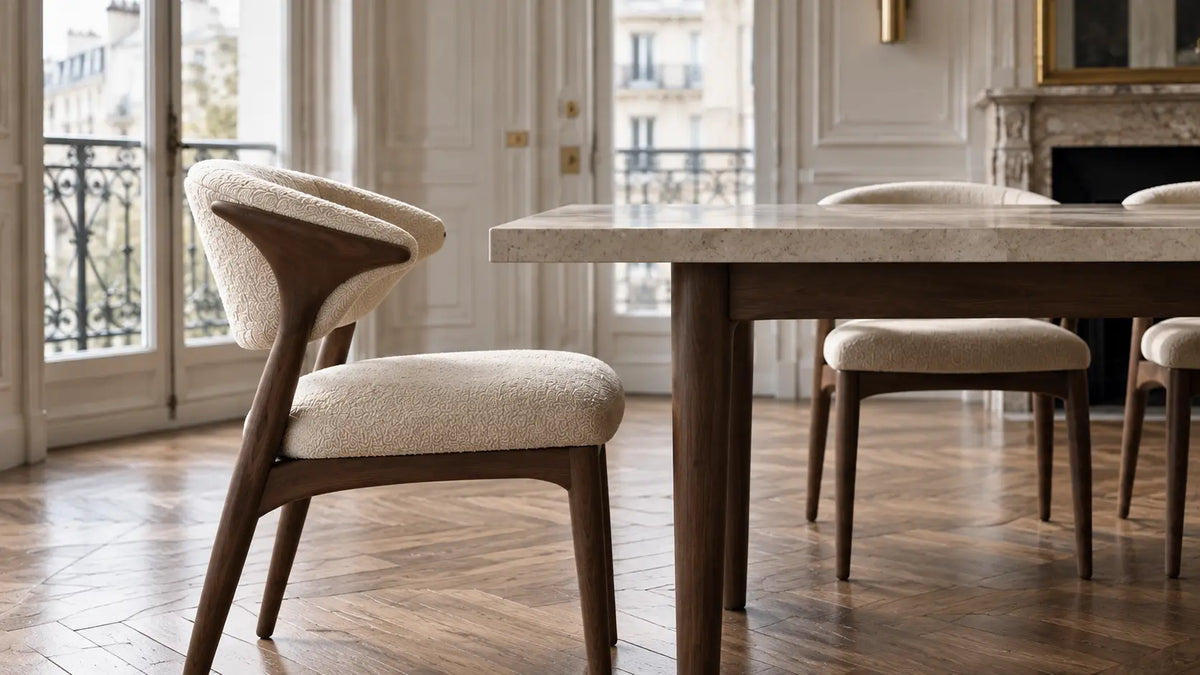
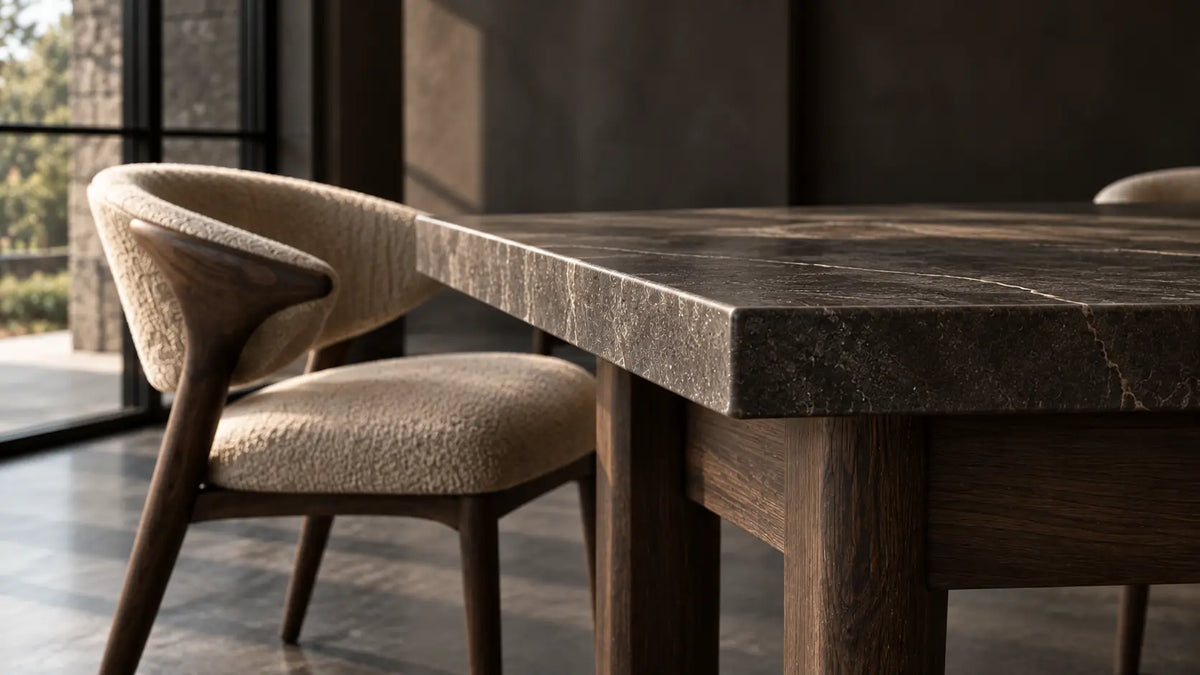
Tabletop thickness is part of the same calculation. A solid wood top is often 1.5 to 2 in / 4 to 5 cm thick, and a stone top commonly sits between 0.8 and 1.2 in / 2 to 3 cm, though a mitered edge can make it appear much heavier. The apron beneath the top takes a further 3 to 4 in / 8 to 10 cm. Together they set the underside of the table, and the clearance under it must still allow knees to pass — about 25–26 in / 63–66 cm from floor to underside, as covered in the piece on table bases.
| Measurement | Typical Range |
|---|---|
| Table height (floor to top) | 29–30 in / 74–76 cm |
| Chair seat height (unloaded) | 17–19 in / 43–48 cm |
| Drop from seat to tabletop | 10–12 in / 25–30 cm |
| Clearance floor to underside | 25–26 in / 63–66 cm minimum |
| Seat compression, upholstered | 1–2 in / 2.5–5 cm |

Side-view diagram of a dining table and chair showing table height, seat height, the drop from seat to tabletop, and knee clearance under the apron.
Armchairs and the Apron
An armchair adds one more height to check: the top of its arms. If the arm is higher than the underside of the apron, the chair cannot slide under the table, and it ends up pulled halfway in, which breaks the line of the room and costs the diner a few inches of table. For armchairs intended to tuck in, the arm height should sit about 1 in / 2.5 cm below the apron. Otherwise the chair is a head-of-table piece and should be specified as one.
Custom Heights
The 29–30 in standard exists because tables are built in volume. On a table made to order, height is a decision, not a default. A tall household, a particularly low-profile chair, or a deep upholstered seat can justify an inch or two either way. What matters is that the table and the chairs are confirmed together, with the real seat height and the real top thickness on the same page.
- Aim for a 10–12 in / 25–30 cm drop from seat to tabletop
- Allow for 1–2 in of compression on upholstered seats
- Keep 25–26 in / 63–66 cm clear under the table for knees
- Check that armchair arms clear the underside of the apron
- Confirm table and chairs together, using the actual measured seat height
A table is only the right height once someone has sat at it for an entire dinner.
Our studio builds dining tables and chairs to order, with the height confirmed against the seat it will be used with. If you're specifying a table and chairs together, our studio team is available to discuss the proportions directly.

Leave a comment
This site is protected by hCaptcha and the hCaptcha Privacy Policy and Terms of Service apply.