
Trestle vs Pedestal vs Leg Base: How Table Base Construction Affects Everything
The top is what people photograph. The base decides where they sit, how they move, and whether the table is still standing straight in thirty years.
Dining table specification conversations start with the tabletop — stone or wood, shape, finish — and treat the base as the thing that holds it up. That undersells it. The base determines legroom, how many people actually fit around a given length, how stable the table is under load, how it handles an extension leaf, and how well it copes with the weight of a stone top. Three base constructions cover nearly every serious dining table: pedestal, trestle, and leg base. Each solves a different problem, and each creates a different one.
The Pedestal Base
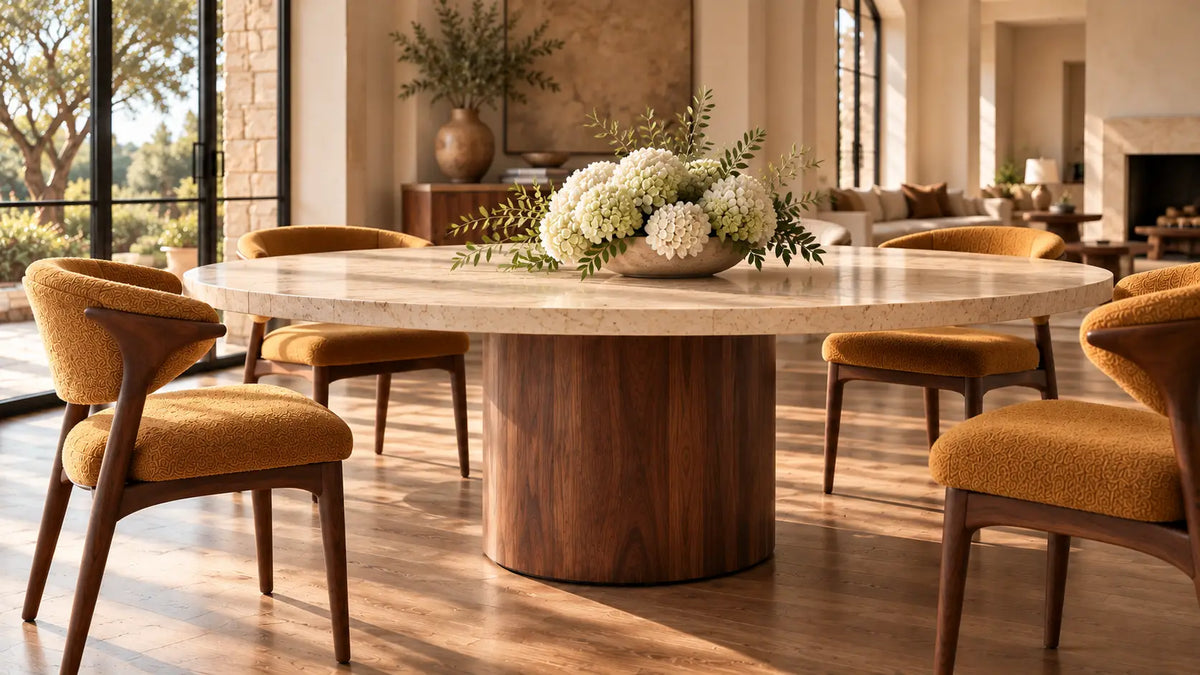
A pedestal base carries the top on a central support — a drum, a column, or a pair of columns on a longer table — rather than on the table's perimeter. Its decisive advantage is that nothing sits at the edge: every seat has unobstructed legroom, no one is assigned a corner with a leg in the way, and chairs can be pulled in from any direction. This is why pedestals are the natural partner of round and oval tops, where the corner problem discussed earlier in this series disappears entirely.
The tradeoff is engineering. A single central support has to keep a loaded top level without help from legs at the corners, which means footprint, weight, and proportion are structural decisions, not stylistic ones. The base needs a footprint wide enough to resist tipping when someone leans on the table's edge, and concealed weight low in the base is a legitimate way to guarantee stability under a stone top. A pedestal drawn too slender for its top is the most common failure in this category — it photographs elegantly and wobbles in use.
The Trestle Base
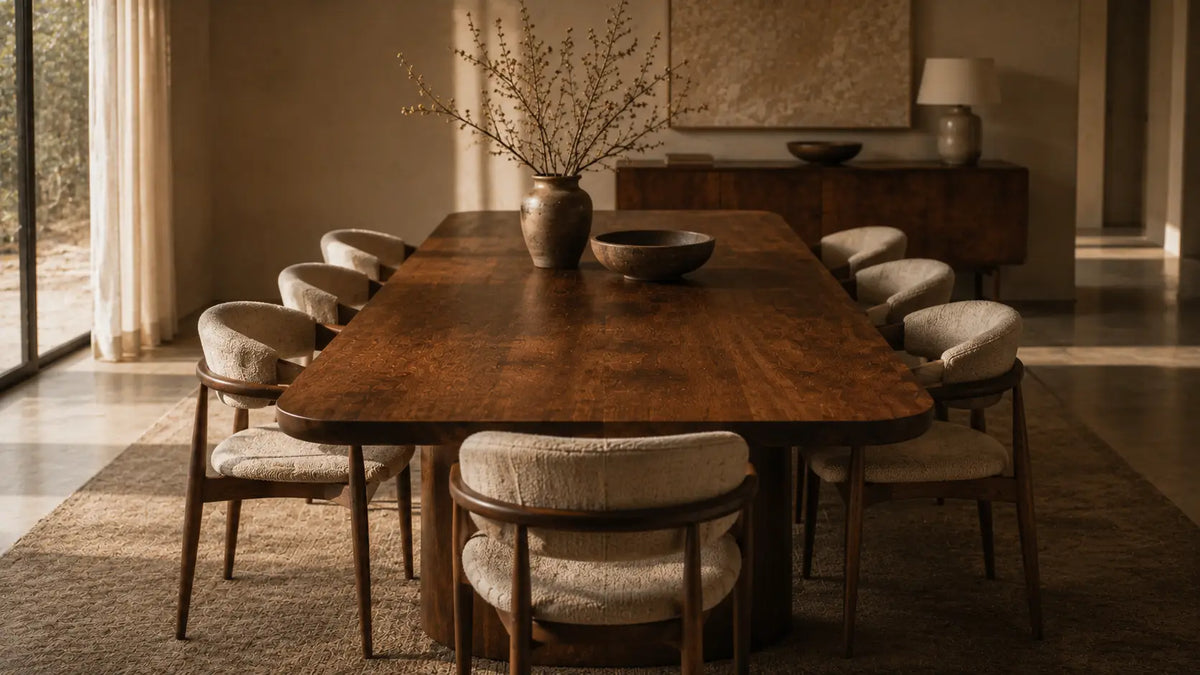
A trestle base uses two end supports joined by a central stretcher or beam, so the table is carried by its ends rather than its corners or its center. It is the traditional answer for long rectangular tables, and for good reason: the load path is simple and strong, the legs sit inboard of the table's ends so end seats stay usable, and the long stretcher resists racking — the sideways wobble that develops in lesser tables over years of use.
The compromise is the stretcher itself. A beam running along the floor or low under the top can catch feet and knees for anyone seated near the middle, so its height and position need to be specified against actual seating, not left to proportion alone. Trestles also tend to read as more architectural and more traditional in character, which suits some rooms and overwhelms others. For an extension leaf, a trestle is generally straightforward, since the end supports stay put while the top draws out.
The Leg Base
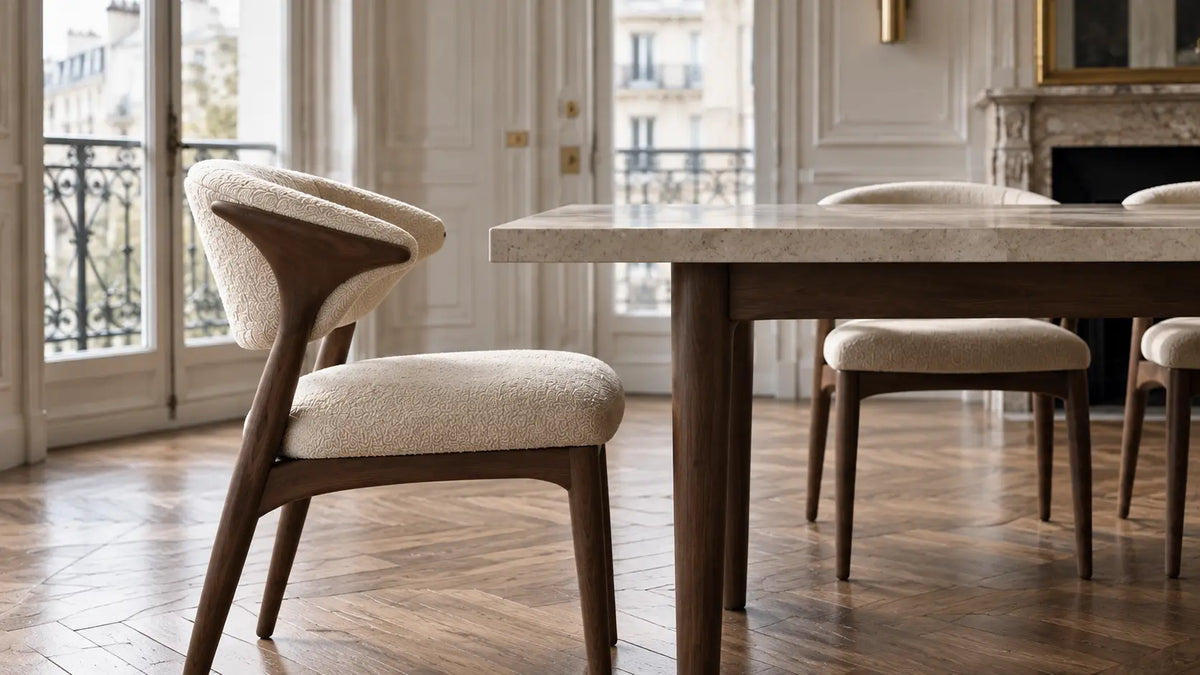
The four-leg base is the most familiar construction: a leg at each corner, usually tied together by an apron beneath the top. It is the easiest to build, the easiest to ship, and the lightest — which makes it the usual choice for wood tables and for upper-floor installations where weight matters. It also scales gracefully to any length, since legs can be added at intervals on a very long table.
Its weakness is geography: corner legs occupy exactly the positions where people want to sit. The apron reduces knee clearance along the sides, and a leg at each corner turns the end seats into compromised positions. Inset legs — pulled in from the corners rather than flush with them — recover much of that space and are worth specifying on any table that will regularly seat its full capacity.
What the Base Does to Seating
Two numbers govern comfort at any table: roughly 24 in / 60 cm of width per person along the edge, and enough height under the top for knees — a clear space of about 25–26 in / 63–66 cm from floor to the underside of the table or apron. A pedestal table passes both tests at any seat. A trestle passes them everywhere except where the stretcher interferes. A leg base passes them along the sides and fails at the corners. The same top, on a different base, seats a different number of people comfortably — which is why seat count should be confirmed against the base, not the top alone.
Weight, Stone, and Wood Movement
The base also has to match the material it carries. A stone top is heavy and does not move; it needs a base that supports it across enough of its area, and an overhang calibrated by the fabricator to the stone's thickness and span, not eyeballed. A solid wood top moves with humidity, as covered in the winter dining room piece, and needs to be fixed to its base with fastenings that let it expand and contract rather than locking it rigid — otherwise the wood eventually wins the argument and splits. The base is where that allowance is built in, which is one more reason it deserves specification attention equal to the top.
Base Comparison
| Criterion | Pedestal | Trestle | Leg Base |
|---|---|---|---|
| Legroom | Unobstructed at every seat | Good, except around the stretcher | Compromised at corners |
| Best top shapes | Round, oval, short rectangle | Long rectangle | Any shape and length |
| Stability | Depends on footprint and base weight | Strong, resists racking | Strong when well joined |
| Weight | Heavy to very heavy | Moderate to heavy | Lightest |
| Extension leaf | Difficult | Straightforward | Straightforward |
| Visual character | Sculptural, calm | Architectural, traditional | Light, open |

- Round or oval top: a pedestal removes the corner problem entirely
- Long rectangular top seating eight or more: trestle, or a double pedestal, before a plain four-leg base
- Four-leg base: specify inset legs so end and corner seats stay usable
- Pedestal under stone: confirm footprint, proportion, and concealed base weight for stability
- Solid wood top: confirm it is fixed to the base with fastenings that allow seasonal movement
- Confirm seat count against the base, not just the tabletop dimensions
A table's silhouette is chosen from above. Its comfort, stability, and longevity are decided from underneath.
Our studio builds dining tables to order, with the base engineered for the top it carries and the number of people it will actually seat. If you're weighing base constructions for a commissioned table, our studio team is available to discuss the options directly.

Leave a comment
This site is protected by hCaptcha and the hCaptcha Privacy Policy and Terms of Service apply.