

Five Dining Rooms That Get It Wrong — and Why
Most dining room mistakes are not taste failures. They are specification failures — a rule that was never applied, not a room that was never loved.
The dining rooms that don't work rarely fail because of poor instincts. They fail because a specific, checkable rule was skipped somewhere in the process. Here are five of the most common failures we see, and the specification that would have prevented each one.
1. The Round Table in a Rectangular Room
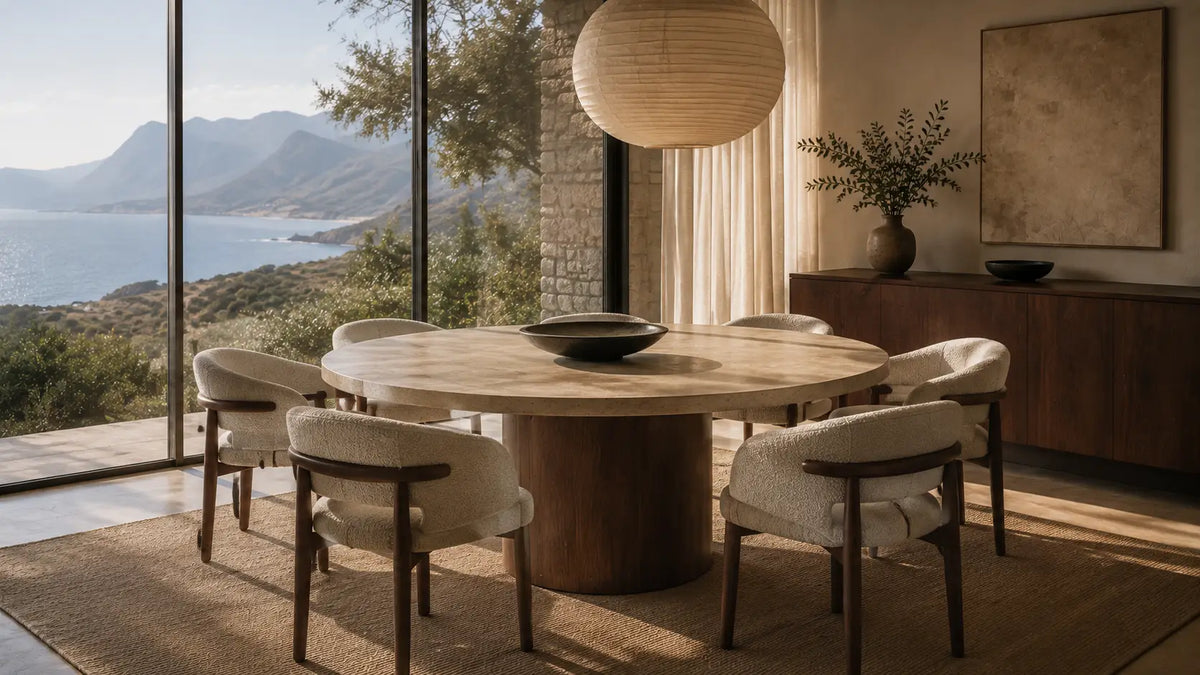
A round table demands a room shape it rarely gets. In a rectangular room — the overwhelming majority of American dining rooms — a round table leaves the room's long axis feeling empty while the short axis feels tight. The fix isn't a smaller round table. It's usually an oval, which fills the rectangular footprint while keeping round's corner-free seating logic intact.
2. The Rug That's Two Sizes Too Small
This is the single most common dining room failure, and the easiest to diagnose: stand up from any chair and check whether all four legs stayed on the rug. If they didn't, the rug is undersized. The rule is a minimum of 24–30 in / 60–75 cm of rug beyond the table's edge on every side, measured at the chair's pulled-back position — not the table's resting footprint.

3. Three or More Chair Styles at One Table
Mixing chairs can read as curated restraint or as an unplanned accumulation, and the difference is almost always the number of distinct styles at the table. Two styles, sharing a common wood tone or upholstery family, reads as a decision. Three or more, without a clear organizing logic, reads as a room that never finished deciding what it wanted to be.
4. The Sideboard Longer Than the Table
A sideboard is meant to support the table, not compete with it. When the sideboard's length matches or exceeds the table's, the visual hierarchy of the room collapses — nothing reads as the primary piece. The proportion that consistently works is a sideboard at roughly 60–75% of the table's length, positioned with enough clearance behind seated chairs that the two pieces never collide functionally.

5. The High-Gloss Table in a Room Built for Warmth
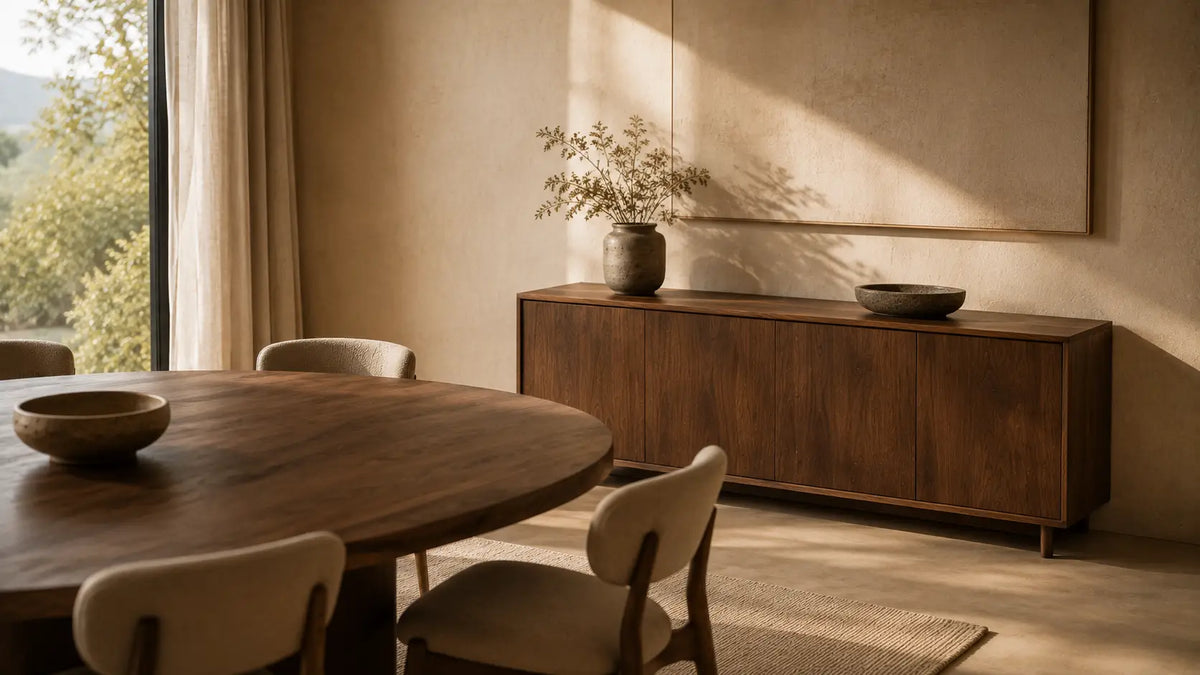
A room styled around natural materials — linen, boucle, raw plaster, unlacquered brass — undercuts itself with a high-gloss lacquered tabletop at its center. Gloss lacquer resists the exact aging process — oxidation, patina, tonal depth — that gives every other material in the room its warmth. The table ends up looking newer and colder than everything around it, permanently, instead of aging into the room the way the rest of the materials do.
- Round table in a rectangular room → reconsider oval
- Rug smaller than the chair's pulled-back position → resize up
- Three or more chair styles at one table → cut to two with a shared anchor
- Sideboard equal to or longer than the table → resize to 60–75% of table length
- High-gloss tabletop in a natural-material room → specify a matte or oiled finish instead

None of these five mistakes come from a lack of taste. They come from a rule that was never checked before the order was placed.
Our studio builds tables and chairs to the specifications that avoid these exact failures — sized, shaped, and finished for the room they'll actually occupy. If you're working through a dining room brief and want a second read on the specifications, our studio team is available to walk through it directly.

Leave a comment
This site is protected by hCaptcha and the hCaptcha Privacy Policy and Terms of Service apply.