

Extendable or Fixed-Size: Should a Luxury Dining Table Extend?
An extending table solves one evening a year. A fixed table serves the other three hundred and sixty-four. The question is which of the two the room is for.
Few buyers can say with certainty how many people will sit at their table over the next twenty years. An extendable table promises an answer: small on an ordinary evening, large for the holiday dinner. In practice, the promise has a cost in appearance, in mechanics, and in material, and it does not suit every table. Whether to extend is a design decision, not only a practical one, and it deserves to be made before the table is drawn.
How Extending Tables Work
Three mechanisms cover most extendable dining tables. A drop-in leaf is a separate section, stored elsewhere and set between the two halves of the table when needed. A butterfly leaf is folded and stored under the top, and opens out as the two halves are pulled apart. A sliding or telescopic table moves on rails, with the leaf rising from beneath or the ends pulling out. Each trades convenience for complexity, and each leaves its own mark on the design.
What an Extending Table Gives
The advantage is flexibility. A table that seats six on an ordinary night and ten at the holidays does not fill the room for the other days of the year, which matters in an apartment or a smaller dining room, as discussed in the piece on the dining room for two. For a household that entertains in occasional large bursts, this can be the most sensible way to own one table instead of two.
What It Costs
The first cost is the seam. An extending top is made of sections, so a joint runs across the surface even when the table is closed. On a design built around one continuous plane of wood, that line is a compromise. The second is the grain and color of the leaf: it must match the top, but wood ages and darkens with light, so a leaf stored in a closet will not look the same as a top that has stood in the sun, as covered in the piece on daylight and the dining table.
The third cost is mechanical. Rails, runners, and hinges are moving parts that wear, and they need accurate construction to keep the surface flat across the joint. The fourth is the base: a central pedestal does not always allow a top to open, and an extending table asks for supports that stay clear of the new seating positions, which limits the base design, as set out in the guide to base construction. Finally, an extra leaf adds weight and another piece to store, handle, and protect.
Stone and Extension
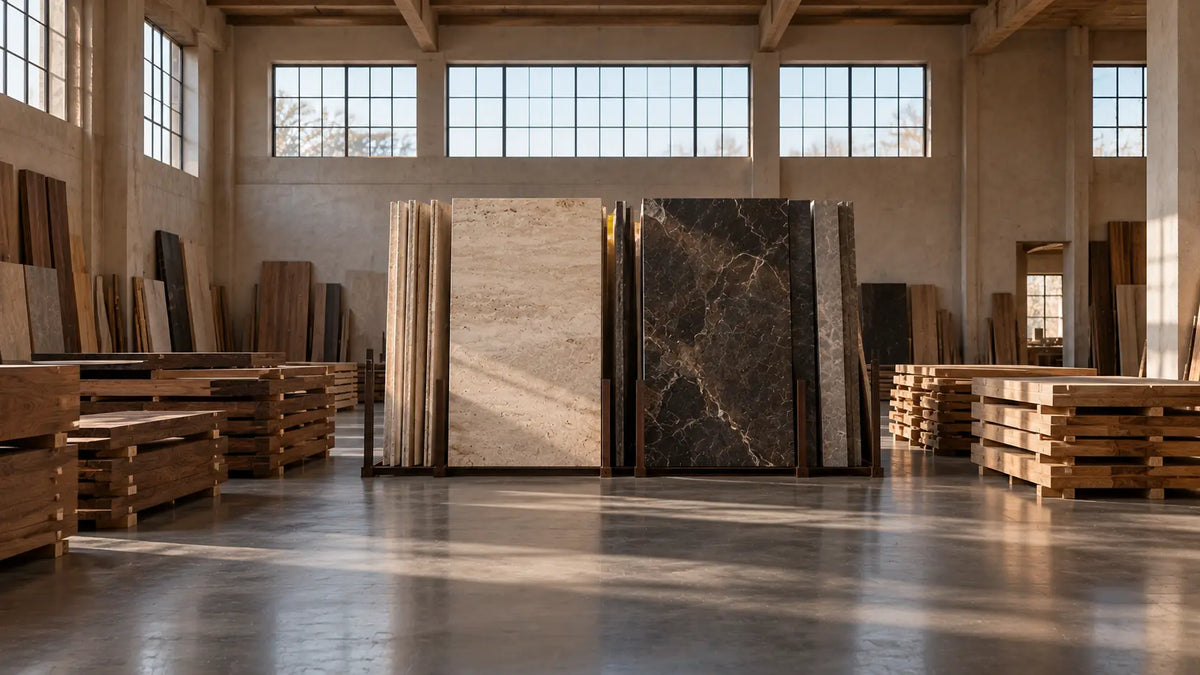
Stone is rarely a good candidate for extension. A stone top is heavy, a leaf in stone heavier still, and a mechanism built to carry that weight adds bulk to the table. A visible seam in stone, with its veining interrupted, is also harder to hide. For this reason stone tables are normally made at a fixed size, with the size chosen generously from the start, as the guide to how a stone table arrives and the piece on sizing by number of guests both suggest.
| Format | Strength | Trade-Off |
|---|---|---|
| Fixed size | One unbroken top, simplest construction | One capacity only |
| Drop-in leaf | Simple mechanism, large gain in length | Leaf to store, color and grain to match |
| Butterfly leaf | Leaf stored in the table itself | Added thickness, visible seam, mechanics |
| Sliding rails | Quick to open, smooth operation | Most complex, limits the base |
The Alternative: A Generous Fixed Table
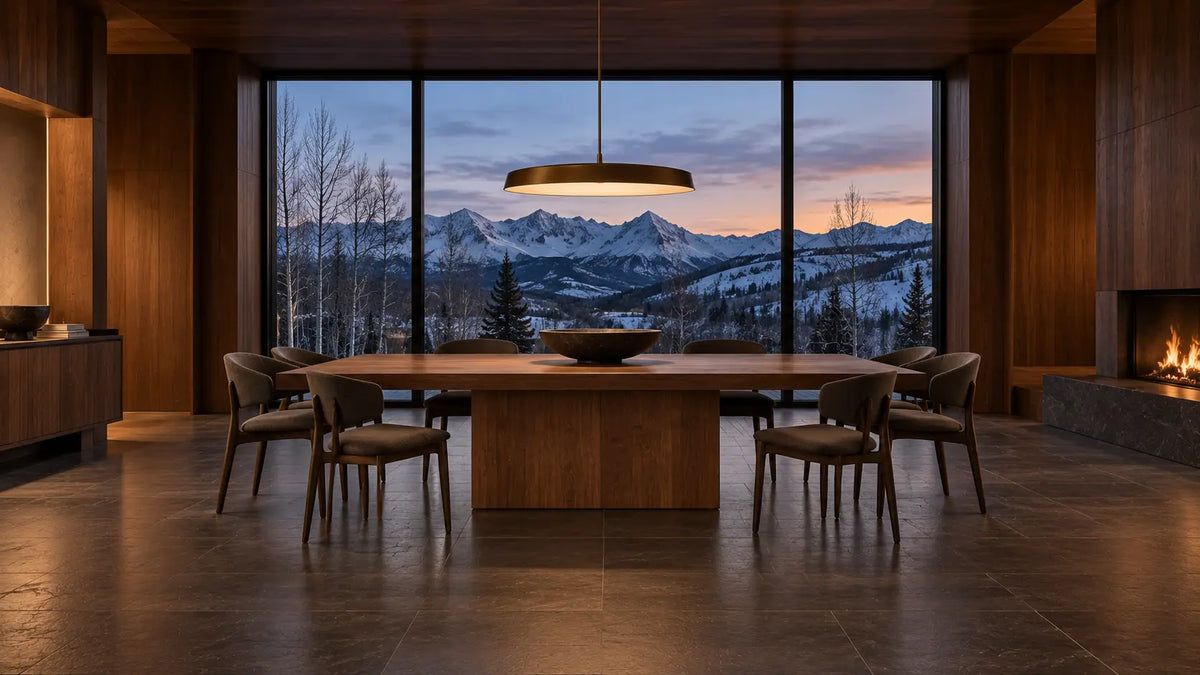
The simplest alternative is a fixed table sized for the larger number, which suits a dining room that can carry it. A table of the right proportions need not look empty when only a few are seated, particularly when it is an oval or has a generous base. For an occasional large dinner, extra chairs and a second surface are often easier than a mechanism, and the table keeps the single uninterrupted plane that most designers prefer.
The One Extendable Model in Our Collection
Our collection is made of fixed-size tables, with one exception: Harja, a rectangular solid wood table designed to extend. It follows the principles above. A butterfly leaf, grain-matched to the top, is stored folded inside the table, so there is no separate piece to keep elsewhere. Concealed synchronized steel runners carry the extension and keep the top flat without a center leg, and the legs sit at the corners so the ends stay clear for chairs. Closed it measures 163 cm (64 in) and opens to 264 cm (104 in). It is made in solid walnut, natural oak, or ebonized oak, with a hardwax oil finish, and a fixed version can be specified on request.
- Decide first how often the table will actually seat its largest number
- Accept the seam, the extra weight, and the moving parts if flexibility matters most
- Match the leaf's grain and color, and store it flat and away from heat
- Check that the base allows the top to open without chairs or supports in the way
- Choose a fixed size for stone, and size it generously from the start
- Consider a larger fixed table and extra chairs for the occasional large dinner
A table should be as large as the room can carry on the day it matters, and as quiet as the room needs the rest of the year.
Our studio builds dining tables and chairs to order. If you're weighing a fixed or an extendable format for your project, our studio team is available to discuss the options directly.

Leave a comment
This site is protected by hCaptcha and the hCaptcha Privacy Policy and Terms of Service apply.