
Article: Provenance: Where the Stone and Wood Come From
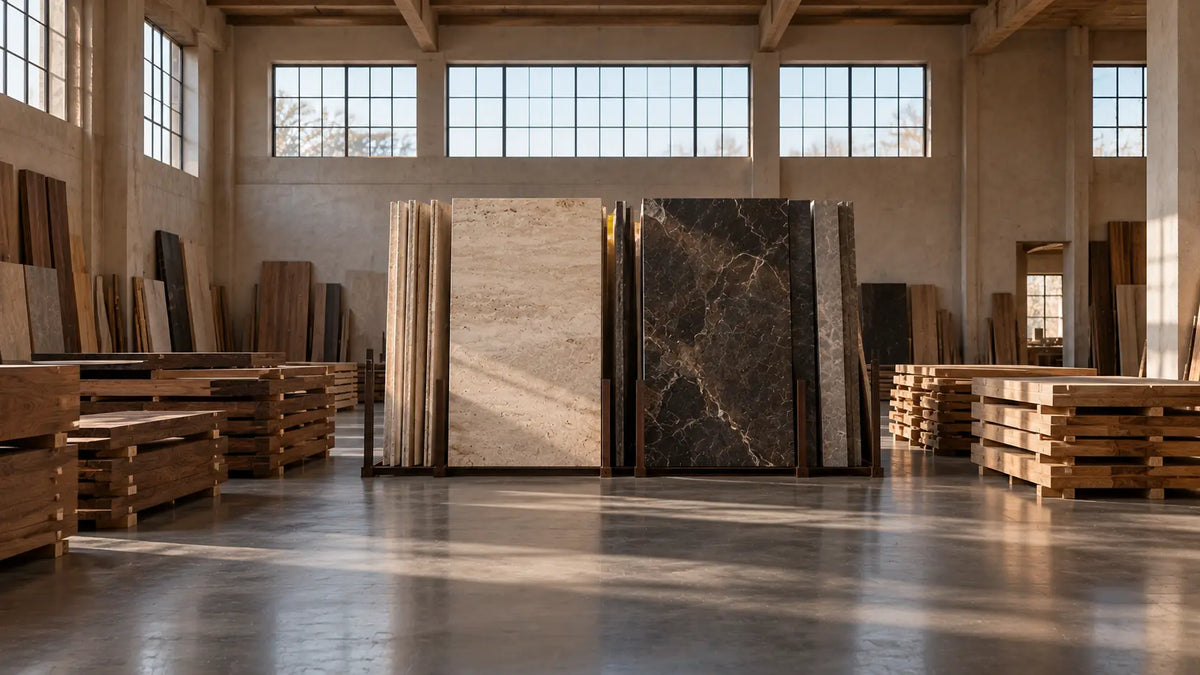
Provenance: Where the Stone and Wood Come From
Every stone was a mountain and every board was a tree. Knowing which, and where, is part of owning the table.
Buyers of a fine dining table ask about size, finish, and price. Fewer ask where the material came from, though the answer shapes the character of the table, the ethics of buying it, and the confidence with which it can be kept for decades. A slab of travertine from the hills outside Rome and a slab of travertine from elsewhere can look alike in a photograph and differ in color, density, and behavior. A walnut board from a managed forest and one of unknown origin can look identical on the table and be very different in what they stand for. This guide sets out what provenance means for stone and for wood, and which questions to put to a maker.
Why Provenance Matters
There are three reasons, and they reinforce one another. The first is character: stone and wood take their color, grain, and density from the place where they formed or grew, and the best-known origins are known for a reason. The second is responsibility: material that is quarried or felled carelessly has a cost that the buyer does not see, and traceable material is the only reliable way to avoid it. The third is continuity. A table that can be traced to a quarry or a forest can be repaired, matched, and, if need be, extended with the same material years later, a point that matters for the heirloom and collectible tables discussed in earlier pieces of this Journal.
Stone: From Quarry to Slab
Stone is named for where it comes from, and the names carry meaning. Travertine, the pale, banded stone behind many of the most admired contemporary tables, is quarried in Italy near Tivoli, east of Rome, and in other regions such as Turkey, each with its own tone and density. White marble with dramatic grey veining, sold under names such as Calacatta, comes from the Apuan Alps in the region around Carrara, in Tuscany. Nero Marquina, a deep black marble with fine white veins, takes its name from Markina in Spain's Basque Country. Dark green marbles such as Verde Alpi come from the Italian Alps, and basalt is a volcanic stone found where lava has cooled into dense, fine-grained rock.
Two cautions apply. First, many stone names are trade names rather than protected designations, so the same name can be used for stone from different quarries, and sometimes from different countries, with visibly different results. The only reliable answer is to ask for the quarry and country of origin. Second, stone varies within a single quarry. Slabs cut from different blocks, or from different parts of one block, will differ in color and veining, as the guide to reading a slab explains. A maker who sources a slab for a specific table can choose it, and can keep the pieces for a table and its matching surfaces from the same block.
Wood: From Forest to Board
For wood, provenance begins with the species and its region. American walnut is a native of the eastern and central United States, prized for its deep color and fine grain. Oak is grown in both North America and Europe, and the two can differ in tone and in the character of the grain, as discussed in the guide to walnut, oak, and ash. Ash is available from both continents, though supply has tightened in recent years, with large stands lost to a beetle infestation in North America, which is one reason very wide ash boards are harder to source, as noted in the piece on species.
The second layer is how the wood was grown and felled. Certification schemes such as FSC and PEFC verify that timber comes from forests managed for long-term health and that the chain from forest to maker is documented. In the United States, the Lacey Act prohibits trade in illegally harvested timber, which makes documentation a legal as well as an ethical matter for anyone importing or selling wood products. A maker who can name the species, the region, and the supplier, and who can show the paper that supports them, is offering something more reliable than a general assurance.
The third layer is preparation. Boards that have been slowly dried to the right moisture content and sorted by color and grain before they are glued up make a more stable and more even top, as covered in the pieces on joinery and on the lead time. This is part of provenance too: a good board has a history, and the history shows in the finished table.
| Material | Well-Known Origins | What to Ask |
|---|---|---|
| Travertine | Italy (Tivoli), Turkey | Which quarry, and whether it is vein-cut or cross-cut |
| White and grey marble | Italy (Carrara, Apuan Alps) | Quarry and country, since the name alone may not say |
| Black marble | Spain (Basque Country) | Whether the slab is from a single block |
| Basalt | Volcanic regions | Origin and finish of the surface |
| Walnut | Eastern and central United States | Species, region, and certification |
| Oak | United States, Europe | American or European, and how it was dried |
| Ash | United States, Europe | Supply, board width, and lead time |
Distance, Transport, and Weight
Stone is heavy, and where it is quarried and where it is worked are often far apart. A slab may be quarried in one country, cut and finished in another, and shipped again to the maker, which adds to the footprint of the table and to the points at which something can go wrong, as the guide to how a stone table arrives describes for the last stage. Asking where the stone is cut and where the table is made is a fair question, and a short chain is usually a sign of a maker who knows the material well.
What Provenance Gives the Owner
Beyond reassurance, provenance gives practical benefits. It lets a repair or a matching piece be made from the same material. It gives the table a story that can be told to guests and, one day, to a buyer, which matters for the pieces that hold their value, as covered in the guides to the collectible table and to the table as an investment. And it connects the object to a place, which is a large part of why people choose natural materials at all, and of why patina is welcomed rather than feared, as the piece on patina argues.
- Ask for the country and the quarry of the stone, not only its trade name
- Ask whether the slab was selected for the table, and whether matching pieces come from the same block
- Ask for the species and region of the wood, and for FSC or PEFC certification where it applies
- Ask for the documentation that supports the answer, not only the answer itself
- Ask where the material is cut, finished, and assembled, and how it is transported
- Ask how the wood was dried and how the boards were selected and matched
- Keep the origin details with the table, for repair, matching, and resale
A table that can say where it comes from has already answered most of the questions it will be asked.
Our studio builds dining tables and chairs to order, in stone and in solid wood. If you'd like to know more about the materials for a commissioned table, our studio team is available to discuss them directly.


Leave a comment
This site is protected by hCaptcha and the hCaptcha Privacy Policy and Terms of Service apply.