
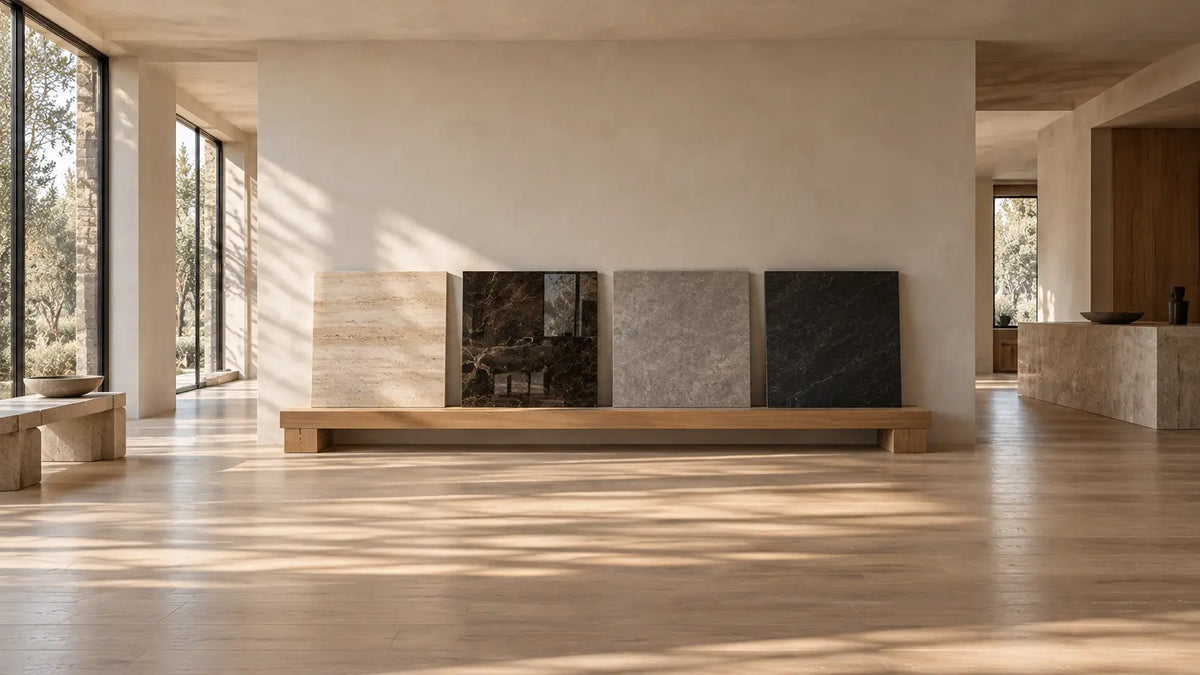
Honed, Polished, Brushed or Leathered: Choosing the Stone Finish
The stone chooses the color. The finish chooses how the table will look, feel, and age every day it is used.
Buyers of a stone dining table spend most of their time on the choice of stone: marble, travertine, onyx, or a dark limestone. The surface finish gets far less attention, yet it decides how the same slab reads in the room, how it shows marks, and how it feels under the hand. Two tables cut from the same block can look like two different materials, one mirror-bright and one soft and matte. Four finishes cover almost every dining table, and each answers a different brief.
Polished: Depth and Reflection
A polished surface is ground until it reflects light like glass. It deepens the color of the stone and sharpens the veining, which is why it is the finish of choice for dramatic marble, onyx, and dark stone. It also shows everything: fingerprints, scratches, and above all etching, the dull marks left on marble by lemon, wine, or vinegar. On a polished top an etched ring is visible at once, because it breaks the reflection. The surface also mirrors the windows and lamps around it, which adds life to a dim room and glare to a bright one, as set out in the piece on daylight and the dining table.
Honed: The Quiet Standard
A honed surface is smoothed but not polished, leaving a soft, satin matte. It diffuses the light instead of mirroring it, so the stone reads calmer and more natural, and etching shows far less because there is no reflection to break. For this reason honed is the most common finish for stone dining tables, and the usual recommendation for a household that uses its table. The trade-off is that a honed surface is slightly more open and takes stains more readily, so it should be sealed, and the sealing renewed over time, as explained in the guide to stone table care.
Brushed: Texture and Warmth
A brushed finish, sometimes called antiqued, is made by working the surface with abrasive brushes that lightly wear away the softer parts of the stone. The result is a gentle, slightly irregular relief that feels aged and tactile. It suits travertine and limestone, where it echoes the natural pitting and character of the material, as discussed in the piece on travertine. It hides wear well, but crumbs and dust settle in the texture and need a brush or a damp cloth to clear.
Leathered: Grip and Grain
A leathered finish is produced by passing diamond-tipped brushes over the stone, leaving a fine, undulating texture, like the grain of hide. It belongs to harder, darker stones and to quartzite, where it deepens the color and hides fingerprints almost completely. It is also the least even of the four. Glasses and plates sit less steadily on it, and it is harder to wipe, so it suits a table that is admired more than it is laid, or a household that accepts a more tactile surface.
| Finish | Look and Feel | Shows | Suits |
|---|---|---|---|
| Polished | Glossy, reflective, deep color | Etching, scratches, fingerprints | Dramatic marble, onyx, formal rooms |
| Honed | Satin matte, calm | Stains if unsealed | Everyday dining, most stones |
| Brushed | Soft relief, aged, warm | Crumbs and dust in the texture | Travertine, limestone |
| Leathered | Fine grain, tactile, dark | Uneven under glasses, harder to wipe | Dark stone, quartzite |
Choosing by Use, Not by Photograph
A finish looks different in a sample photograph than on a table seen daily under the room's own light. The most reliable way to choose is to ask how the table will be used. A table for daily family meals points to honed. A table for a formal room, used less often and admired more, can carry a polished finish. A stone with strong natural texture points to brushed. Whatever the choice, judge a finished sample of the exact stone in the room itself, at different times of day.
- Choose polished for depth and drama, and accept that etching and marks will show
- Choose honed for everyday use, and seal it and renew the sealing over time
- Choose brushed for travertine and limestone, and for a softer, aged look
- Choose leathered for dark stone and quartzite, if an uneven surface is acceptable
- Prefer honed in rooms with strong direct sun, to limit reflection and glare
- Judge a finished sample in the room, in its own light
Four finishes, one stone. The right one is the one that suits the way the table will be lived with.
Our studio builds dining tables to order, in stone and in solid wood, and the finish can be discussed on request. If you're choosing between finishes for a stone table, our studio team is available to talk through the options directly.

Leave a comment
This site is protected by hCaptcha and the hCaptcha Privacy Policy and Terms of Service apply.