
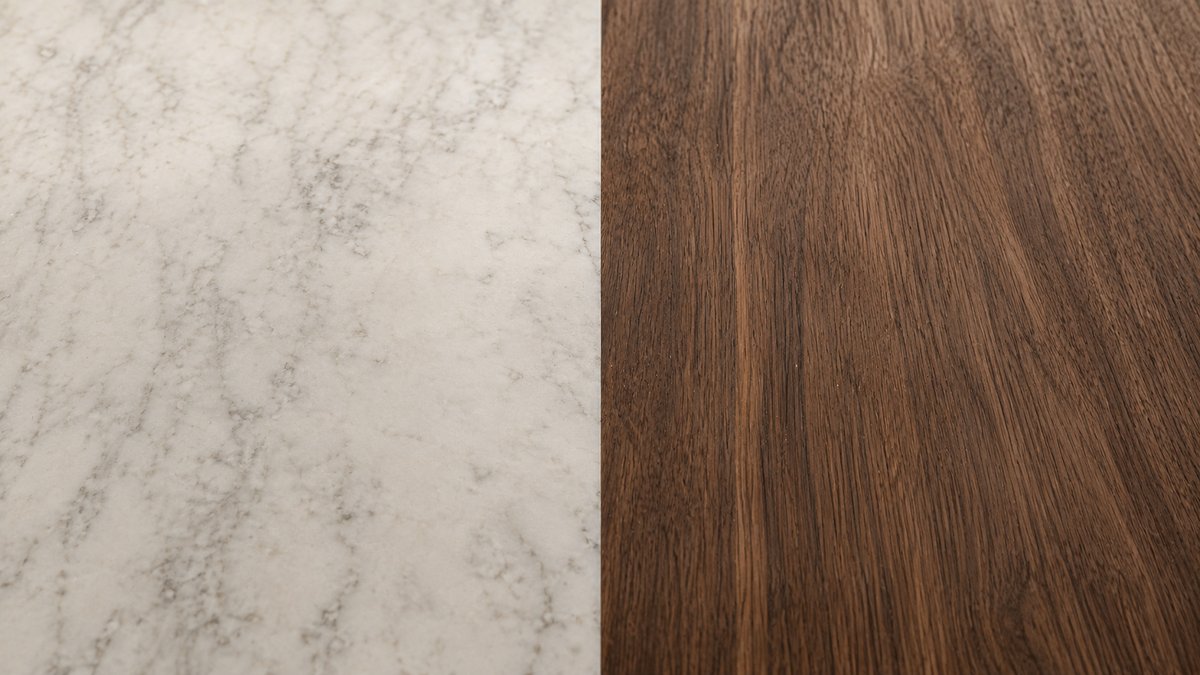
Stone vs Wood: How to Make the Final Decision
Stone and wood are not two finishes on the same decision. They are two different relationships to time — one that resists it, and one that records it.
The stone-versus-wood question arrives in nearly every dining table brief, and it is almost always framed as an aesthetic preference. It isn't. The two materials perform differently under heat, scratch, weight, and decades of use — and they age by opposite logics. Getting this decision right means understanding what each material actually does over a twenty-year ownership horizon, not which one photographs better on day one.
This guide lays out the practical case for each material, where the decision is genuinely close, and where it isn't close at all.
The Practical Case for Stone
Stone's core advantage is indifference. A honed marble, quartzite, or travertine top does not scorch under a hot dish, does not scratch under normal cutlery contact, and does not require refinishing after a decade of daily use. For a household that entertains often, cooks seriously, or simply wants to stop thinking about coasters, this indifference is the entire value proposition.
The tradeoffs are structural rather than cosmetic. Stone is heavy — a 200 x 100 cm slab at 2 cm thickness weighs roughly 90–110 kg before the base is added, which affects delivery logistics, upper-floor installations, and the structural specification of the base itself. Stone requires periodic sealing depending on porosity, and acidic spills — wine, citrus, vinegar — can etch unsealed or honed surfaces if left standing. And stone does not forgive a single mistake the way wood does: a chip in a stone edge is a repair job for a stone fabricator, not something an owner sands out themselves.
The Practical Case for Wood
Wood's core advantage is repairability and warmth — both textural and thermal. A solid wood top is comfortable to the touch in a way stone structurally cannot be, and minor damage — a scratch, a small burn, a water ring — can typically be sanded and refinished rather than requiring specialist fabrication. This makes wood the lower-anxiety choice for households with young children or a high frequency of daily, informal use.
Wood is also significantly lighter, which matters for upper-floor installations, and it carries acoustic warmth that stone does not — a wood table absorbs more sound than it reflects, which changes how a dining room feels during a long dinner. The tradeoff is vulnerability to heat and scratching that stone does not share: a hot pan directly on an unprotected wood top will mark it, and deep scratches are visible in a way they simply are not on honed stone.
Direct Comparison
| Criterion | Stone | Wood |
|---|---|---|
| Heat resistance | Excellent — direct heat rarely marks it | Poor — requires trivets and pads |
| Scratch resistance | Excellent on honed finishes | Moderate — visible but repairable |
| Repairability | Requires specialist fabrication | Sandable and refinishable by most furniture restorers |
| Weight | Heavy — logistics and structural considerations apply | Light to moderate |
| Maintenance | Periodic sealing depending on porosity | Occasional oiling or waxing |
| Tactile temperature | Cool to the touch | Warm to the touch |
| Acoustic effect | Reflective — louder dining room | Absorptive — softer acoustic |
| Visual character over time | Essentially unchanged for decades | Develops patina — darkens and softens with age |
Where Stone Wins Decisively
Stone is the correct answer without qualification in three scenarios. First, households that cook and entertain frequently and want zero anxiety around hot cookware or wine spills. Second, spaces built around a statement material moment — a large-format bookmatched slab with dramatic veining does something no wood grain can: it reads as a singular, irreplaceable object rather than a produced piece of furniture. Third, any installation where long-term visual consistency matters more than tactile warmth — stone genuinely does not change in twenty years, which is valuable in resale-conscious properties or spaces designed for permanence.
Where Wood Wins Decisively
Wood is the correct answer without qualification in three scenarios. First, households with young children, where the ability to sand out a scratch or repair a chip without specialist involvement removes real friction from daily life. Second, upper-floor installations where the structural weight of stone complicates delivery or floor loading. Third, any room where acoustic warmth and tactile comfort — the sense of a table that invites lingering rather than performing — outweighs the desire for a zero-maintenance surface.
The Hybrid Answer
The specification decision does not have to be binary. A stone top on a solid wood base is one of the most consistently resolved combinations in contemporary dining furniture — it delivers the heat and scratch performance of stone on the surface that experiences daily use, while the wood base introduces warmth, visual weight distribution, and a lighter overall footprint than an all-stone construction. This hybrid approach is worth considering seriously before defaulting to an all-stone or all-wood specification, particularly for rounds and ovals where a sculptural wood pedestal can carry real design presence.
- Frequent entertaining, minimal maintenance tolerance → stone
- Statement bookmatched slab as room focal point → stone
- Young children, high daily-use tolerance for wear → wood
- Upper-floor installation, weight-sensitive delivery → wood
- Want stone's surface performance with wood's visual warmth → hybrid stone top, wood base
- Long-term unchanging appearance is a priority → stone
- Developing patina and character over time is desired, not feared → wood

The right material is not the one that looks best in a rendering. It is the one whose relationship to time matches how the room will actually be used.
Our studio builds dining tables in both natural stone and solid wood, as well as hybrid stone-top and wood-base configurations — each made to order to the specification that fits the room. If you're weighing stone against wood for a specific project, our studio team is available to discuss the tradeoffs directly.


Leave a comment
This site is protected by hCaptcha and the hCaptcha Privacy Policy and Terms of Service apply.