

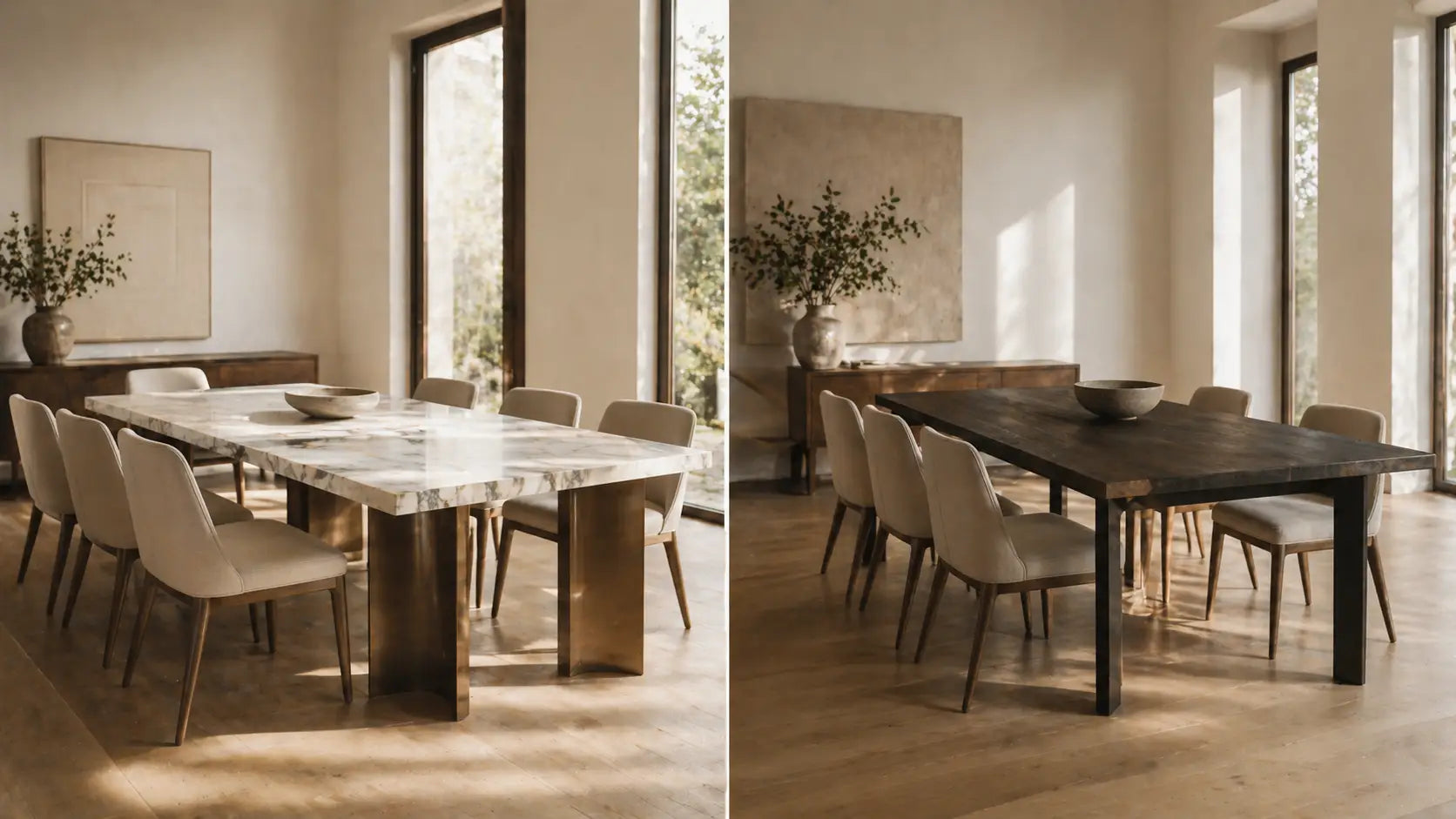
Stone Top vs. Solid Wood Top: Pros, Cons, and the Projects They Suit
"Stone and wood are not interchangeable answers to the same question. They are answers to different questions entirely."
The most fundamental material decision in dining table specification is also the most frequently reduced to a matter of preference: stone or wood? In reality, this is a spatial, structural, and long-term commitment that deserves considerably more analytical rigour than "I've always loved marble" or "I prefer the warmth of wood."
Both materials belong in the luxury residential canon. Both have a centuries-long pedigree in significant interiors. Both age with dignity when correctly specified and maintained. The question is not which is superior — it is which is correct for the project, the client, and the life the table will live.
*Stone asks you to accept its permanence. Wood asks you to accept its living nature. Neither is a compromise — both are commitments to a different kind of beauty.*
|
|
|
|
|---|---|---|
| Visual impact |
Exceptional
Every slab unique — veining creates natural drama at any scale
|
Strong
Grain warmth and depth — ebonised finishes approach stone's gravity
|
| Daily use |
Moderate
Waterproof surface but etches under acid contact — seal annually
|
Forgiving
Scratches sand out — surface can be refreshed without specialist
|
| Weight |
Heavy
80–200 kg for a standard top — requires engineered base and delivery planning
|
Manageable
30–80 kg typical — standard delivery and installation
|
| Longevity |
Generational
Dimensionally stable — no warping, no humidity response, outlasts the building
|
Decades
Solid construction survives refinishing cycles — veneer does not
|
| Maintenance |
Annual sealing
Honed finishes more forgiving — polished surfaces show every mark
|
Regular oiling
Oil or wax finish every 6–12 months — lacquer reduces frequency
|
| Acoustic quality |
Reflective
Hard surface amplifies room acoustics — compensate with soft furnishings
|
Softening
Natural acoustic dampening — reduces echo in hard-surfaced interiors
|
| Price tier |
High – Very high
Premium slabs (Calacatta, onyx) command significant premiums — justified by uniqueness
|
Mid – High
Solid hardwood accessible at mid-luxury — ebonised and rare species approach stone pricing
|
| Best suited for |
Formal dining rooms · Open-plan anchors · Collector interiors · Statement briefs
|
Family homes · Warm-toned interiors · Daily-use dining · Acoustic-sensitive spaces
|
The stone top — permanence as a design position
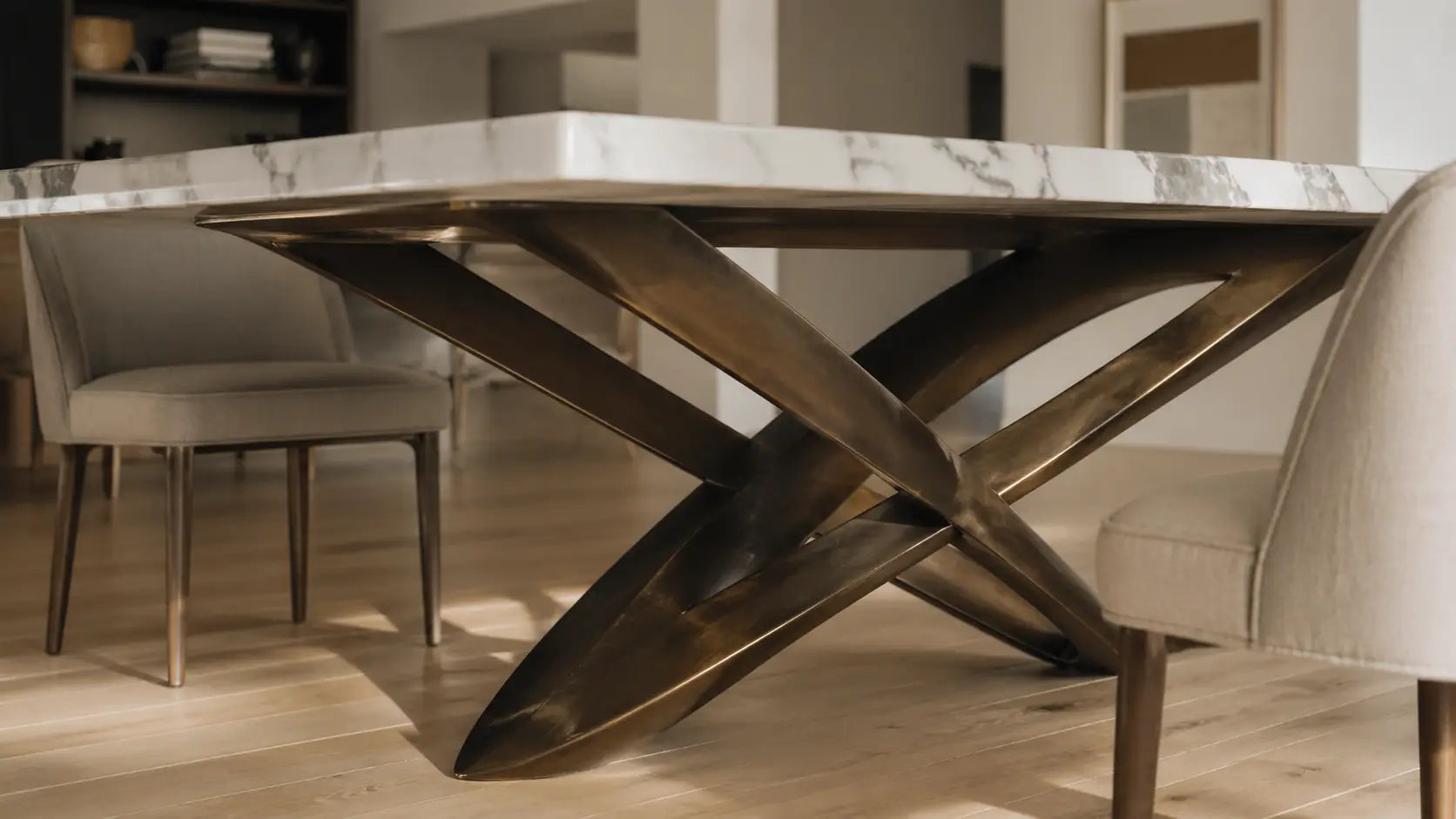
A stone dining table top is, first and foremost, a geological object. The slab was formed over millions of years, quarried from a specific location on earth, and will outlast every other element in the room — including the building. This is not hyperbole; it is a specification reality that changes the nature of the purchase entirely. When a client specifies a 5 cm Calacatta Oro top, they are not buying furniture. They are acquiring a material object that will move through generations.
The practical implications follow from this permanence. Stone does not warp, does not respond to humidity changes, and does not require refinishing. What it does require is an acceptance of its surface chemistry: natural stone is porous and reactive. Marble etches under acidic contact. Travertine requires sealing. Onyx demands attentive handling. For clients who understand and embrace these properties — who see the patina of use as part of the material's biography — stone is the correct specification at any price point.
*The client who says "I don't want to worry about it" is not the stone client. The client who says "I want a table that will still be here in fifty years" almost always is.*
- Specify stone for: formal dining rooms, collector interiors, open-plan spaces needing visual mass, clients with low daily-use anxiety
- Slab thickness to specify: 3 cm standard, 4–5 cm for statement pieces — the edge profile communicates quality immediately
- Finish considerations: honed for daily-use rooms (more forgiving of marks), polished for formal or low-use spaces
- Structural note: stone tops require bases engineered for load — verify weight capacity before specifying any base, especially pedestal configurations
The solid wood top — warmth as a spatial argument
Solid wood is the material that makes a dining room feel inhabited. Where stone commands, wood welcomes. Where stone creates visual tension, wood resolves it. This is not a lesser position — in many interiors, and for many clients, it is the more intelligent one.
The critical distinction in the luxury tier is between solid wood and veneered construction. A solid walnut top — 4 cm thick, book-matched, with a fine oil finish — is a material object of genuine quality. A veneered MDF top with a walnut face is not. The former will still be repairable and beautiful in thirty years; the latter will delaminate, swell, and fade. At the price points Maison Ilmarinen operates in, there is no argument for veneer construction in a dining top.
Ebonised oak and blackened walnut occupy a particular position in the current market — they bring the tonal gravity of dark stone without its weight or surface vulnerability, and they pair naturally with the bronze and brass hardware that defines the contemporary luxury register. For clients who want the drama of a dark material with a warmer daily experience, ebonised hardwood is often the most persuasive specification.
- Specify solid wood for: warm-toned interiors, family dining rooms with daily use, projects where acoustic softness is a brief requirement
- Species to specify: solid oak, solid walnut, ebonised oak — all have the grain density and stability for dining top use
- Finish recommendation: natural oil for authentic tactile experience; hard wax oil for better liquid resistance in high-use homes
- Humidity management: solid wood tables should be kept away from direct heat sources and maintained at consistent indoor humidity — critical specification note for new builds
Which projects suit which material
Specify stone when —
The interior is predominantly hard surfaces. The client entertains formally. The table needs to anchor an open plan. The brief includes the word "statement". The budget justifies a collectible-tier acquisition.
Specify solid wood when —
The interior is warm-toned with natural textiles. The household includes young children. The brief emphasises daily comfort over formal impact. The client wants a table that feels lived-in rather than curated.
Stone wins on —
Visual drama, dimensional stability, thermal presence, collectible value, and longevity without maintenance intervention.
Wood wins on —
Tactile warmth, acoustic comfort, repairability, lighter weight for installation, and the ability to evolve with the room over time.
*The most resolved interiors often answer this question not by choosing one or the other, but by giving each material its correct room. Stone in the formal dining room. Solid wood in the kitchen dining zone. Both present, both correct.*
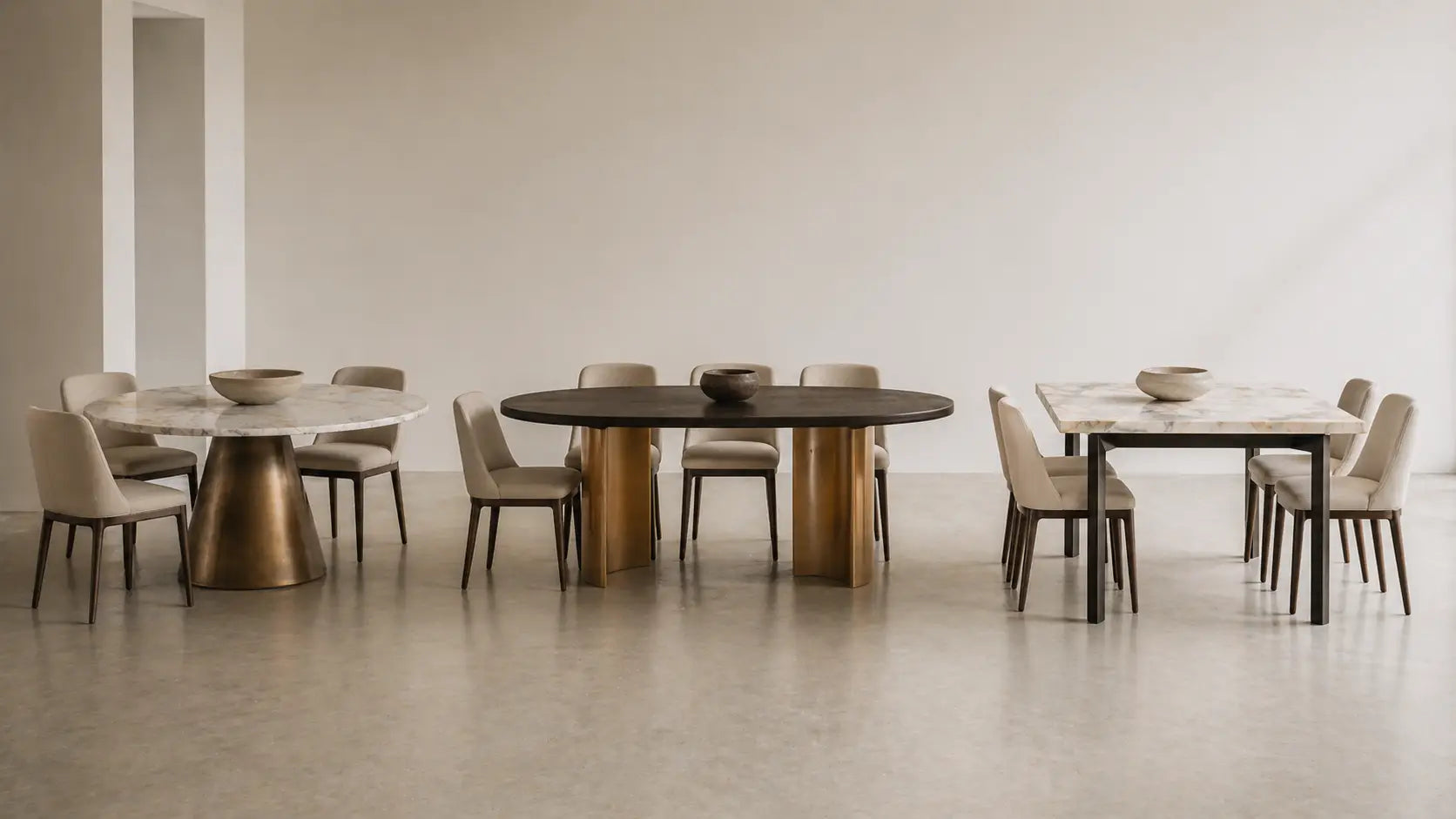
The Maison Ilmarinen collection offers both material families at the same level of craft resolution — stone tops specified at 4–5 cm slab thickness, solid wood tops in species and finishes selected for their long-term performance. If you are resolving a material decision for a current project, our studio team is available for direct consultation.

Leave a comment
This site is protected by hCaptcha and the hCaptcha Privacy Policy and Terms of Service apply.