

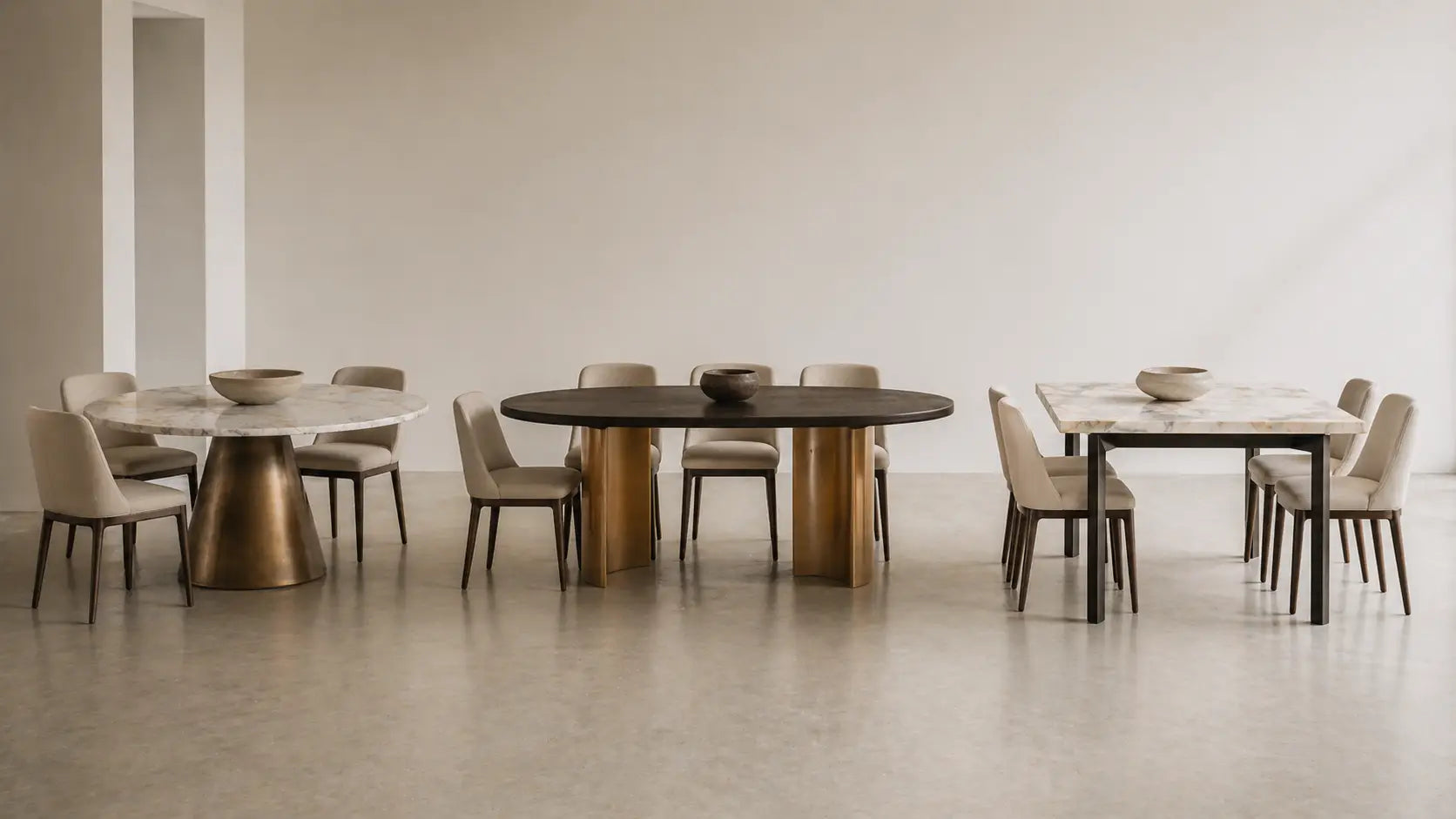
Round vs. Oval vs. Rectangular Dining Tables: A Designer's Decision Framework
"The shape of a dining table is not a preference. It is an answer to a spatial question."
The question "round, oval, or rectangular?" is one of the most frequently asked in dining table specification — and one of the most frequently answered on instinct rather than analysis. Clients have preferences. Designers have aesthetics. But the correct answer to this question is almost always determined by the room, not by taste.
Each form carries a distinct spatial logic, a set of social implications, and a set of conditions under which it excels or fails. Understanding these conditions is the difference between a beautiful table that works and a beautiful table that fights the space every day.

The round table — intimacy and equality
The round table is the most socially democratic of the three forms. With no head position, no hierarchy of placement, and equal distance between all seated guests, it creates a conversation dynamic that rectangular tables structurally prevent. This is not a soft consideration — for clients who entertain frequently and value the quality of dinner conversation, the round table is a functional specification choice, not merely an aesthetic one.
Its spatial limitation is equally structural: a round table requires more floor area per seat than any other form. The reason is geometric — the circular footprint does not tile efficiently against walls or in rectangular rooms. A round table that seats eight comfortably requires a room clearance of approximately 4.5 × 4.5 metres. Below this, it reads as a spatial compromise.
The round table asks one question of the room: is the space generous enough to let it breathe? If the answer requires hesitation, specify an oval instead.
- Ideal room shape: square or near-square dining rooms where the circular form echoes the spatial proportions
- Seating range: 4 seats (120 cm diameter) to 8 seats (180 cm diameter) — beyond 8, the table becomes too wide for comfortable conversation across
- Base recommendation: pedestal — eliminates corner leg obstruction and maximises seating flexibility
- Avoid in: long narrow rooms, open-plan spaces where the form will read as spatially indecisive
The oval table — the designer's solution
The oval is the form that resolves the most briefs. It retains the social warmth and visual softness of the round table while adding the dimensional efficiency of the rectangular form. In a rectangular room — which describes most dining rooms — an oval table occupies the space with a coherence that a round table rarely achieves and a rectangular table sometimes makes too rigid.
It is also the most seating-generous form relative to its footprint. The curved ends allow more chairs to be placed comfortably than a rectangular table of equivalent length, and the absence of sharp corners improves circulation in tighter spaces. For clients who entertain at scale but have rooms of moderate dimension, the oval is almost always the correct answer.
*The oval table is what you specify when the brief requires everything: social warmth, spatial efficiency, and enough visual softness to prevent the room from reading as a boardroom*
- Ideal room shape: rectangular dining rooms of standard proportion — the oval mirrors the room's logic without copying it
- Seating range: 6 seats (200 cm length) to 12 seats (300 cm length) — the most scalable form in the range
- Base recommendation: two-column or sculptural central base — four-leg bases on ovals can feel spatially awkward at the curved ends
- Works equally well in: open-plan spaces, dedicated dining rooms, and kitchen-dining configurations
The rectangular table — architectural authority
The rectangular table is the most architecturally legible of the three forms. Its right angles echo the geometry of walls, windows, and doorways — creating a spatial coherence that curved forms achieve through contrast rather than correspondence. In a strongly architectural interior — a loft, a double-height space, a room with significant structural elements — the rectangular table is the form that holds its position with the most conviction.
It is also the form that scales most dramatically. A 300 cm rectangular table in a significant material — thick Emperador Dark marble, solid ebonised oak — makes a statement that no other form in this dimension can match. This is the table that defines the room rather than accommodating it.
- Ideal room shape: rectangular rooms with strong architectural character — lofts, converted spaces, formal dining rooms with high ceilings
- Seating range: 6 seats (180 cm) to 14+ seats (340 cm) — the only form that scales convincingly beyond 10 seats
- Base recommendation: four-leg for visual permeability, sculptural for collectible register — pedestals work only on narrower formats
- Consider carefully: end seating clearance with four-leg bases, and whether the formal hierarchy of the form matches the client's entertaining style
The decision framework
Three questions resolve the form decision in most projects:
Question 1 — Room geometry :
Is the room square? Round or oval. Is it strongly rectangular with architectural character? Rectangular. Is it rectangular but moderate in scale? Oval.
Question 2 — Seating count
Under 6 seats: round works. 6–10 seats: oval is most efficient. 10+ seats: rectangular is the only convincing solution at scale.
Question 3 — Social dynamic
Does the client value egalitarian conversation? Round or oval. Do they host formal dinners with clear hosting positions? Rectangular.
Question 4 — Design register
Is the table the room's primary gesture? Rectangular at scale, or a significant round pedestal piece. Is the room already architecturally strong? Oval as the diplomatic solution.
| Form | Best room | Seating | Social dynamic | Design register |
|---|---|---|---|---|
|
Round
|
Square or generous
Min. 4.5 × 4.5 m for 8 seats
|
4 – 8 seats
Pedestal base recommended
|
Intimate, no hierarchy
Equal distance, equal voice
|
Warm, residential
Collector or family register
|
|
Oval
|
Rectangular, moderate
Most versatile room fit
|
6 – 12 seats
Two-column or sculptural base
|
Social, fluid
Soft hierarchy at ends
|
Refined, versatile
The designer's default
|
|
Rectangular
|
Architectural, loft
Strong structural character
|
6 – 14+ seats
Only form that scales beyond 10
|
Formal, hierarchical
Clear host position
|
Authoritative, collectible
Statement at scale
|
The Maison Ilmarinen collection offers all three forms across multiple material families — each shape available in the configurations that make it spatially and formally correct. If you are resolving a form decision for a current project, our studio team welcomes the conversation.

Leave a comment
This site is protected by hCaptcha and the hCaptcha Privacy Policy and Terms of Service apply.