

Article: The 10 Design Principles Behind Timeless Dining Room Furniture
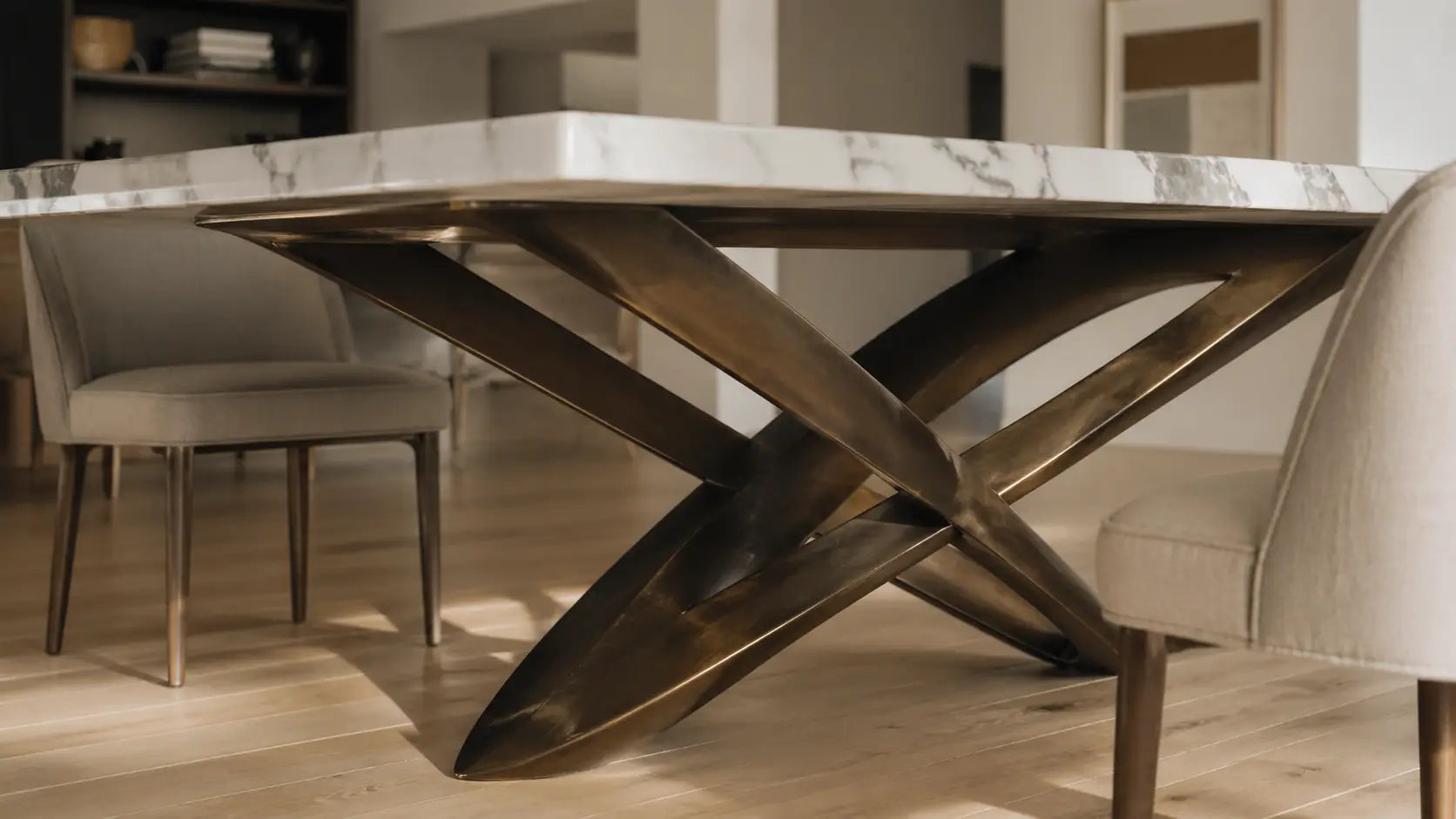
The 10 Design Principles Behind Timeless Dining Room Furniture
"Trends are answered by seasons. Principles are answered by decades."
The dining room is the most emotionally significant space in a home. It is where celebrations happen, where difficult conversations are held, where families and friends return to a fixed point in an otherwise changing world. The furniture that inhabits this space carries a weight that no other category of interior object carries — and it should be chosen accordingly.
Timeless does not mean conservative. It does not mean safe. It means that the piece will still be correct — spatially, aesthetically, structurally — in twenty years. These ten principles are the filter through which every piece in the Maison Ilmarinen collection has been resolved. They are offered here as a specification tool for designers, architects, and buyers who are making decisions they intend to live with for a very long time.
The question is never "is this beautiful today?" The question is "will this be right in the room when everything else in the room has changed?"
Decoration is the first thing that dates. A piece that relies on ornament for its visual interest becomes a period object within a decade. Proportion — the relationship between height, width, depth, top thickness, leg dimension — operates below the level of conscious taste. A correctly proportioned table reads as right before the viewer understands why. This is where the design intelligence of a piece either exists or does not.
Restraint is not absence of ambition — it is the most demanding design position of all. To resolve a dining table in three elements — top, base, junction — with no superfluous detail requires a level of formal confidence that ornamentation bypasses. The pieces that remain relevant across decades are almost invariably the ones that committed to doing less, better.
The edge of a table top is where the hand meets the material every time someone sits down. It is the most tactile detail in the piece and the one most consistently underspecified. A 3 cm waterfall edge in honed Calacatta, a barely-there 2 mm chamfer on ebonised oak, a full bullnose in travertine — each communicates a different design position and a different price register. The edge is where the quality of the decision is felt, literally.
A timeless piece makes its structure visible and coherent. The viewer should be able to understand, at a glance, how the piece stands — how the load transfers from top to base to floor. Pieces that obscure their structure through excessive mass or decorative overlay invite a subtle unease that compounds over time. Structural clarity is a form of visual honesty.
Timeless furniture does not resist the room changing around it. It provides the fixed point from which the room can change without losing its centre.
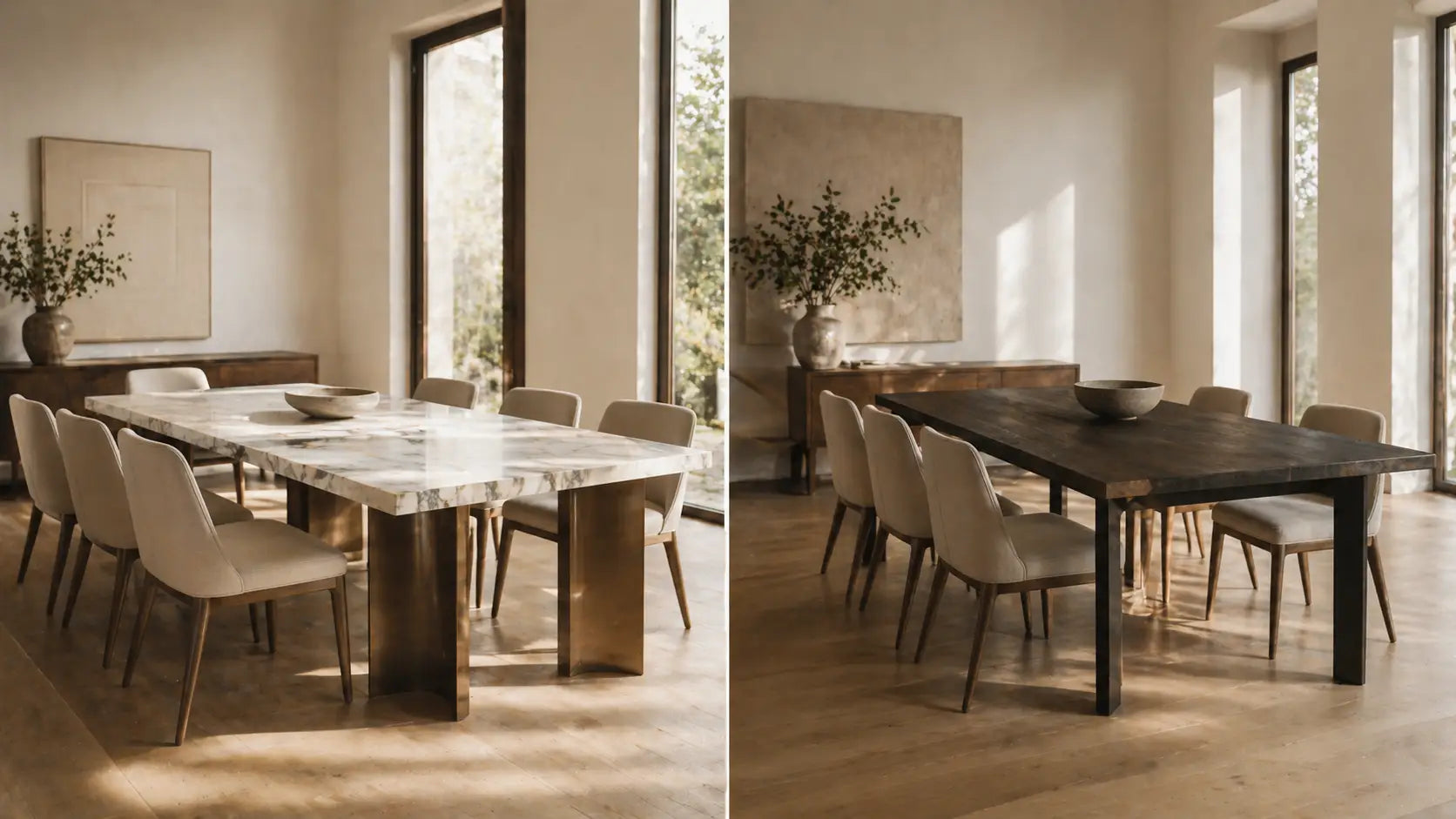
The most coherent dining tables share a material logic between top and base — not necessarily the same material, but a related conversation. A Nero Marquina top with a blackened steel base shares a tonal register. A travertine top with a travertine pedestal shares a material identity. When top and base are chosen from entirely different material families with no formal relationship, the piece reads as assembled rather than designed.
A dining table must work at the scale of the body, not the scale of the room. Standard height — 73 to 76 cm — exists for ergonomic reasons that have not changed since the form was established. A table that prioritises visual impact over ergonomic correctness will be uncomfortable to sit at for extended periods, and comfort is the primary brief of the dining table. Scale to the human first; the room second.
Materials that age well — natural stone, solid hardwood, cast bronze, unlacquered brass — share the quality of becoming more themselves over time. The Calacatta marble that etches slightly after five years of use is not damaged; it is becoming the table that has lived in this home. Specifying materials that resist or conceal aging produces pieces that look the same at year twenty as they did at delivery — a form of material stasis that reads, eventually, as lifelessness.
Where the base meets the top is the most technically and aesthetically demanding detail in a dining table. A flush mechanical fixing that leaves no visible fastener reads as resolved. An exposed bolt communicates cost-cutting. A recessed bronze pin communicates craft. This junction — invisible to most buyers, immediately legible to every designer — is where the production quality of a piece is definitively revealed. It is the detail that separates furniture from design objects.
The final principle is not about the piece — it is about the decision. A timeless dining table is chosen for the room it will be in when the walls have been repainted three times, when the chairs have been reupholstered, when the lighting has been updated and the art has changed. The table must be correct for that room, not only for this one. This requires a quality of spatial imagination that distinguishes a purchase from an acquisition.
Every piece in the Maison Ilmarinen collection has been evaluated against these ten principles before entering the range. They are not a checklist — they are a design position. If a piece passes nine of ten, it is a very good table. If it passes all ten, it belongs in the collection.

Leave a comment
This site is protected by hCaptcha and the hCaptcha Privacy Policy and Terms of Service apply.